Bank of Canada Interest Rate Announcement Dates for 2026: Setting the key policy rate or the interest rate is the responsibility of The Bank of Canada, and this is the primary tool that they use to regulate inflation. This rate sets the foundation for establishing many other interest rates in Canada.
The Bank of Canada uses this rate to affect various elements of the Canadian economy like the value of the Canadian dollar relative to other currencies (the exchange rate), consumer price inflation, and bank interest rates, among others.
If you are a homeowner, purchasing a home, or are interested in owning real estate you may have heard about the Bank of Canada and the anticipation that surrounds Bank of Canada Interest Rate Announcement Dates for 2026, so read this article till the end.
What is the Bank of Canada Interest Rate?
The Bank of Canada decides on a target for the overnight rate which is also called the policy interest rate. This is the rate at which large financial institutions borrow money from each other for one night. The Bank does not borrow at the overnight rate and it affects a whole range of Canadian interest rates, for example:
- Variable-rate mortgages
- HELOCs (Home equity lines of credit)
- Personal loans
- Business loans
- Savings accounts
- GICs (Guaranteed Investment Certificates)
Bank of Canada Interest Rate Announcement Dates for 2026
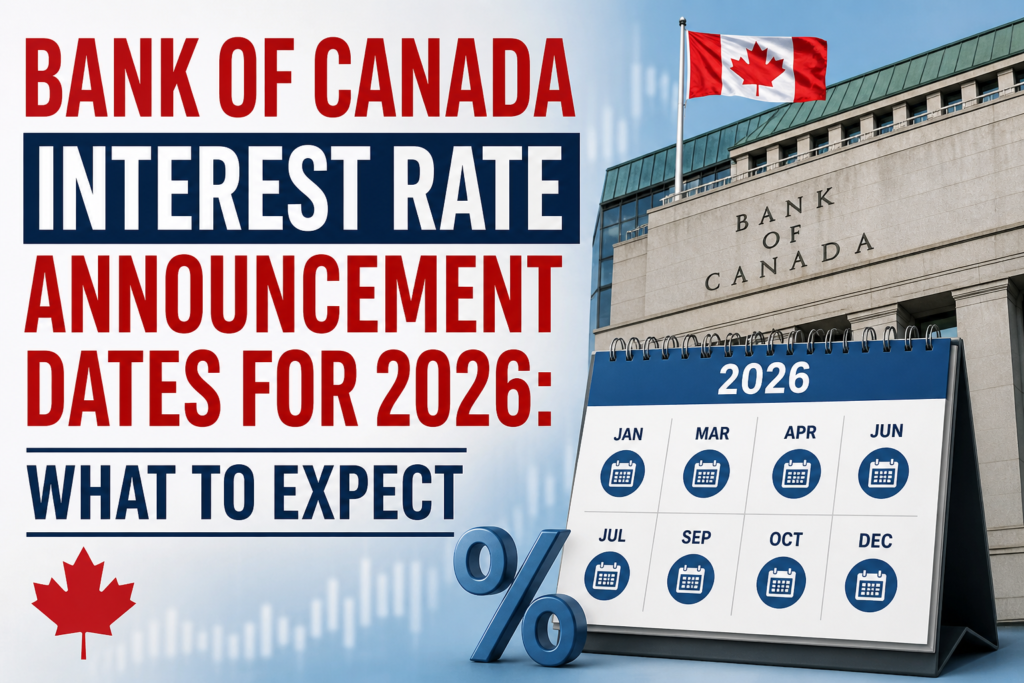
The Bank of Canada is scheduled to release eight interest rate decisions during 2026.
| Announcement Date | Monetary Policy Report (MPR) |
|---|---|
| January 28, 2026 | Yes |
| March 18, 2026 | No |
| April 29, 2026 | Yes |
| June 10, 2026 | No |
| July 15, 2026 | Yes |
| September 2, 2026 | No |
| October 28, 2026 | Yes |
| December 9, 2026 | No |
The Monetary Policy Report announcements are especially important because they include updated forecasts for inflation, economic growth, employment, and future policy risks.
Top 5 Bad Credit Cards Best Options in CanadaBank of Canada Interest Rate 2026: Quick Facts
| Number of Rate Decisions | 8 |
| Inflation Target | 2% |
| Inflation Control Range | 1%–3% |
| Decision Maker | BOC Governing Council |
| Main Policy Tool | Target Overnight Rate |
| Major Impacts | Mortgages, Loans, Savings, Investments |
| Official Source | Bank of Canada |
Why These Dates Matter for Canadians
Bank of Canada interest rate announcement Dates 2026 directly impact variable rate mortgages, lines of credit and GICs due to the way that the overnight target rate flows through the prime rate set by banks. For example, if the decision is made to continue with a hold at 2.25% as has occurred at the beginning of 2026, borrowers continue to face lower borrowing costs while savers will continue to see their savings going down.
Homebuyers and those renewing their current mortgages are watching closely because if the bond market is forecasting increases in fixed rate mortgages, it is likely that fixed rates will increase; whereas, variable rates are instantly affected by changes in the policy rate. Businesses often use these dates to allow them to make investments because businesses that experience an increase in rates tend to reduce their spending or hiring.
In 2026 the current overnight rate is 2.25% as there have been three months of holds (January, March and April); thus, the market is waiting to see whether there will be changes based on significant inflation (currently 2.4%) and lower projected GDP growth (1.1%).
What to Expect From a Bank of Canada Announcement?
The Government of Canada has created monetary policy around which the Bank of Canada manages interest rates. A key responsibility of the Bank is to set the policy rate or target overnight rate used to lend short-term funds between banks daily.
Are Short Loans Costly? Know the Real ChargesPeriodically, the Bank will announce if it has changed this policy rate, informing stakeholders and the public of its direction and any adjustments to the key policy rate.
Changes made to the Bank of Canada policy rate directly impact the prime rate, which is used by most major Canadian financial organizations as a basis for determining the rates charged for loans, lines of credit, and variable-rate mortgages. So when the BOC rate changes, mortgage rates will change accordingly.
What Economists Expect in 2026
According to most economists, the Bank of Canada will probably continue to be conservative in its approach in 2026. Based on surveys carried out by Reuters, most analysts think that the rates are likely to stay constant for most of 2026 unless there is an increase in inflation. However, some of the markets have priced in future rate hikes due to potential threats due to rising crude oil prices and global geopolitical tensions.
Example: How a Rate Change Affects Canadians
A 0.25% interest rate increase can noticeably affect monthly mortgage payments.
For example:
- A homeowner with a $500,000 variable-rate mortgage could see payments hike by approximately $70–$90 per month depending on amortization and lender terms.
- Businesses having variable-rate loans may also face higher financing costs.
- Canadians who owe money on their line of credit accounts will likely incur higher interest payments soon after the rate hike.
On the other hand, a rate cut may reduce borrowing costs and improve affordability for some households.
Factors Influencing 2026 Rate Decisions
Several drivers shape Bank of Canada expectations:
- Inflation Trends: Headline at 2.4% but core is just close to 2%. thus, increases remain on the table.
- Economic Growth: Expected growth at 1.1% is low due to slower immigration levels & trade barriers.
- Labour Market: Labour market is stable but slowing, therefore potentially easier in future.
- Global risk factors: U.S. tariffs; fluctuating commodity prices; Fed actions against Canada.
- Market Signals: “Flattening” yield curves suggest CAD will increase in value if Canadian interest rates decrease relative to U.S. rates.
The BoC remains flexible, with both cuts and hikes on the table per recent signals.
Stop Paying CRA Taxes? What Happens NextHow to Prepare Before a Rate Announcement
Canadians may consider taking several steps prior to each Bank of Canada announcement:
- Assess mortgage renewal possibilities;
- Compare mortgage rates (fixed vs. Variable);
- Analyze debt payment alternatives;
- Analyze savings and investment objectives;
- Keep an eye on inflation and economic news.
Taking such a proactive approach would allow you to more efficiently react to adjustments in the cost of borrowing.
What Is a T4E Form? Canada Benefits GuideShould We Expect Rates to Increase in 2026?
It appears that interest rates will not change in 2026 by large amounts based on current forecasts. The current focus is on maintaining inflation below the Bank’s inflation target (2%), which makes it more likely that the Bank will remain at current rates for an extended period rather than increase them sharply.
If inflation rises quickly or GDP grows more than the Bank expects, the Bank has stated that future decisions to change interest rates will be based on available economic data: inflation trends, wages, and the global economy.
Wrap-Up
To make better financial choices, it is important to Understanding the Bank of Canada interest rate announcement dates for 2026. There are 8 interest-rate announcement dates and 4 major policy announcements during this time. By knowing these dates, you will have a better chance of anticipating rate changes from your lender as well as when the economy might change.
Although 2026 is anticipated to be a cautious and stable monetary year, the global environment as well as inflation trends may produce unforeseen events that will affect interest rate decisions. Being able to watch these dates means you will always be ready for whatever occurs whether you are managing a mortgage, investing, or running a business.
Frequently Asked Questions (FAQs)
When is the next Bank of Canada interest rate announcement in 2026?
The Bank of Canada makes 8 planned interest rate announcements each year. You can follow the official schedule to stay informed about upcoming announcements.
Do interest rate changes affect mortgage rates?
Yes. Variable-rate mortgages and lines of credit are usually affected directly by policy rate changes. Fixed mortgage rates are much more affected by bond market yields than by the Bank’s policy rate decisions.
Could interest rates drop in 2026?
A rate cut could be possible if there is economic conditions weaken or inflation falls below target. The decision will be based on economic data at the time.
Where can i check official interest rate announcements?
You can check on official website of Bank of Canada
Sources
This article is based on official Bank of Canada schedules and verified financial data to ensure accurate and reliable information about interest rate announcement dates.
- Bank of Canada – Official 2026 Interest Rate Announcement Schedule
- Bank of Canada Policy Interest Rate (Official Data & Schedule)
- Bank of Canada Interest Rate Announcement Example (Official Release)
- Bank of Canada – December 2026 Interest Rate Announcement
- RBC – Understanding Bank of Canada Interest Rate Decisions

Ritika's writing philosophy is built on one core principle: every person deserves access to clear, accurate, and actionable benefit information — without having to wade through confusing government language. Her guides are trusted by seniors, working families, and low-income households across North America who rely on timely payment updates and eligibility information.
All content written by Ritika is thoroughly research-based, sourced from official government portals including SSA.gov, Canada.ca, and CRA publications.