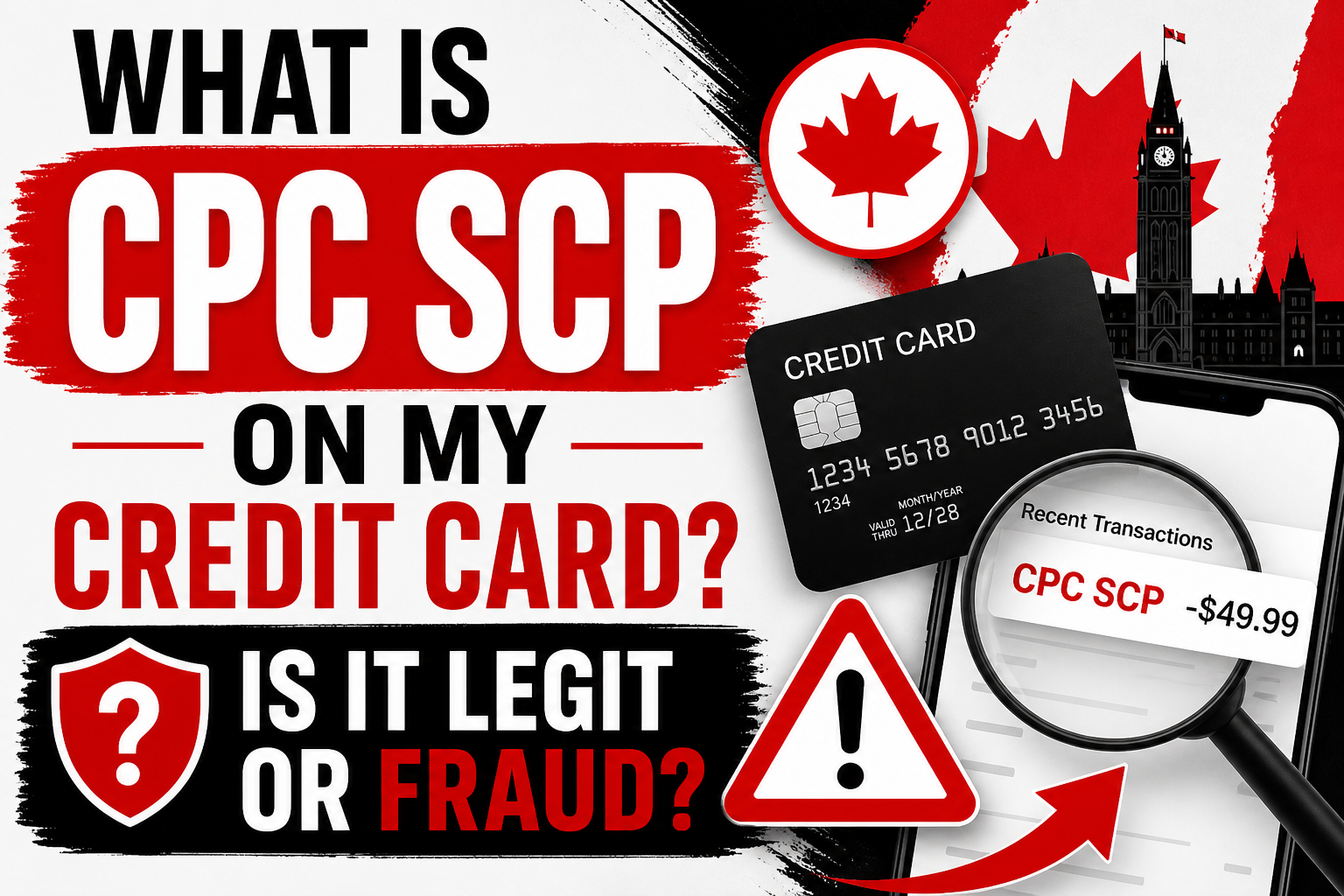
If you have ever checked your credit card statement and noticed a CPC SCP on Credit Card charge, you might be wondering what it is. These types of charges can appear unexpectedly, causing concern among cardholders.
It is almost always a legitimate charge from Canada Post and not a scam by default, but it can become fraudulent if you did not author or benefit from that transaction. Read this article till the end to get answer on- What is CPC SCP on My Credit Card? Is it legit or fraud.
What does CPC SCP mean on a Credit Card?
The CPC SCP on credit card bill is almost always a legitimate charge from Canada Post (Canada Post Corporation / Société Canadienne des Postes). It shows up when you pay to send or receive a parcel via Canada Post or for postage, shipping, or customs charged on a parcel, and is just the way that banks/carding entities short-hand the merchant name.
Explore the best options for bad credit credit cards in Canada .
In most cases this is not a scam charge, but if you did not send, receive or pay for anything related to Canada, you should contact your creditor (issuing bank) to dispute the charge and inquire about the possible misuse of your card.
On many Canadian credit card statements, “CPC SCP” is commonly used as a merchant descriptor associated with Canada Post Corporation (CPC) and its French name, Société canadienne des postes (SCP). The exact wording can vary depending on the card issuer and payment processor.
Is CPC SCP a Legitimate Charge?
If you notice a CPC SCP on your credit card statement, it usually indicates a charge made by Canada Post (Canada Post Corporation), and it occurs when using your credit card’s funds in delivering or receiving items via Canada Post as postage/shipping/customs fees.
If the transaction is not related to your receipt/delivery of items shipped via Canada Post or you did not authorize payment, please dispute the charge with your credit card company and request an investigation into the charge with Canada Post.
For example:
- You recently ordered something from another country
- You paid duties at delivery
- A seller shipped using Canada Post
- You created a shipping label online
Common Legitimate Reasons for a CPC SCP Charge
| Statement Description | Generally Means |
|---|---|
| CPC SCP | Canada Post shipping or postage payment |
| CPC SCP ONLINE | Online Canada Post transaction |
| CPC SCP DUTY | Customs duties or import fees collected by Canada Post |
| CPC SCP RETAIL | Purchase made at a Canada Post outlet |
If the transaction amount matches your recent postal activity, there is usually no reason for concern.
Why Did a CPC SCP Charge Appear on Your Statement?
There are several legitimate reasons why you might see CPC SCP on your credit card:
1. Canada Post Services
CPC SCP is the merchant code for Canada Post Corporation / Société Canadienne des Postes, so this charge usually appears when you pay for:
- Stamps, postage or shipping labels purchased through the Canada Post website or at a registered Canada Post branch.
- Shipping, courier and/or handling charges for a package that you have sent or received via Canada Post.
- Customs duties, taxes or brokerage charges on International shipments received via Canada Post in Canada.
Learn how to check your credit score in Canada for free .
2. Related Online or International Transactions
Sometimes the charge shows up indirectly because:
- If you order from a Canadian online retailer via Canada Post to mail out your order, that retailer will charge either (i) shipping or (ii) customs to your credit card through the Canada Post Courier / Service Centre (CPC/SCP) system.
- Any parcel you receive from outside Canada after paying your first bill will be subject to any import-related fees as charged by Canada Post at the time of delivery, separately from the first bill you paid.
3. When CPC SCP May Be Fraud
Even though CPC/SCP is a real merchant code, it becomes suspicious if:
- You did not ship, receive, or pay for any Canada‑related service.
- The amount, date, or location does not match any known activity.
If that’s the case, you should contact your card issuer to dispute the charge and ask Canada Post for transaction details.
Understand what counts as a good credit score in Canada .
Understand it via Real-Life Examples
Example 1: International Shopping
Jacob orders clothing from a U.S. retailer. When the package arrives in Canada, customs duties of $18.75 are collected by Canada Post. A few days later, he notices a CPC SCP charge for the same amount on his credit card statement.
Example 2: Shipping a Parcel
Rebecca purchases a shipping label via Canada Post website for $14.99. Her statement later shows a CPC SCP charge matching the shipping cost.
Example 3: Potential Fraud
John notices a CPC SCP charge of $2.13 but has not shipped or received any packages recently. After contacting his credit card issuer, he came to know that his card information may have been used without authorization.
How to Verify a CPC SCP Charge
Before disputing the transaction:
- Check your Canada Post account history.
- Review recent package deliveries.
- Look for customs duty payment emails.
- Search your email inbox for Canada Post receipts.
- Compare the charge date with recent shipments.
- Contact Canada Post customer service if needed.
What Should You do If You Don’t Recognize a CPC SCP Charge
If you find an unusual or unknown charge on your credit card statement, follow these steps:
- Review Your Purchase History: Look at recent emails, receipts or account history to see if you can identify the charge otherwise known as a forgotten or verified transaction or see if there is something to look for.
- Look For The Merchant Name: Some merchants may use an unrecognizable name to you. Use your favorite search engine to search for the name that appears on your statement and see if you can find out more.
- Ask Authorized Users: If there are others that are authorized to use your card, ask them if they made the purchase.
- Look At Your Subscription Renewals: You may have subscriptions, memberships or other auto-renewed services that you may have forgotten about, check your subscriptions to see if they match up to this particular charge.
- Contact The Merchant: If you believe that your charge is inaccurate, contact the merchant that appears on your statement.
- Contact to your credit card company: Get in touch with your credit card company and inquire about the charge and the merchant. This may help remember if the charge is legitimate, or will at least provide you with enough information to contest or investigate further. If the charge is not legitimate you will also be able to request that they replace your card if it is not your own charge.
Read about recent Costco Canada issues and updates .
How to Prevent your card from CPC SCP charges
It’s always better to prevent unknown charges that may show up later as CPC and SCP. Below are some tips.
- Stick to secure web sites: Only shop on online retailers that use HTTPS as part of their URL and always use reputable payment processors instead of the website’s own checkout page.
- Never save credit card details: Do not have any saved credit card numbers on websites that you do not trust completely or use infrequently; consider deleting any saved credit cards from your web browser and from any shopping sites to reduce the risk of their misuse.
- Cancel any unused subscriptions: A lot of overlooked charges on your credit card statements happen due to forgotten subscriptions or free trial offers; so check your recurring payments every month and cancel any subscription you no longer need.
- Use a virtual card: If your bank issues virtual cards or one‑time card numbers, use them whenever purchasing things on the Internet so that the actual card numbers are never compromised.
- Check your statements regularly: You should check your credit card and bank statements at least once per week to look for unauthorized charges, including strange names (for example: CPC/SCP), and dispute any unauthorized charge as soon as possible.
Frequently Asked Questions
Is CPC SCP always Canada Post?
Most of the time. CPC SCP typically means Canada Post Corporation and its French acronym
Why do I see CPC SCP after my online shopping?
It’s because most online vendors use the services of Canada Post for delivering their orders or collecting payments for taxes from customs clearance procedures.
What if I don’t understand this CPC SCP entry?
First, check your recent transactions and orders, or look up whether Canada Post charged you something recently. If this doesn’t help, get in touch with your bank or credit card issuer.
Can I make pending CPC SCP charges disappear?
Yes. It’s possible that some authorizations may automatically reverse or disappear within a few business days.
Wrap-Up
A CPC SCP charge is generally for legitimate payments for services rendered by Canada Post such as buying postage, shipping labels, shipping charges for a parcel and customs duties. It is usually nothing to worry about but if the charge is higher than what you would have spent from a recent postal shipment and you do not recognize it after checking your files. You should your credit card provider as soon as possible to investigate the charge to prevent possible fraudulent activity from occurring on your account.
Find out how to settle your CRA debt easily .

Ritika's writing philosophy is built on one core principle: every person deserves access to clear, accurate, and actionable benefit information — without having to wade through confusing government language. Her guides are trusted by seniors, working families, and low-income households across North America who rely on timely payment updates and eligibility information.
All content written by Ritika is thoroughly research-based, sourced from official government portals including SSA.gov, Canada.ca, and CRA publications.