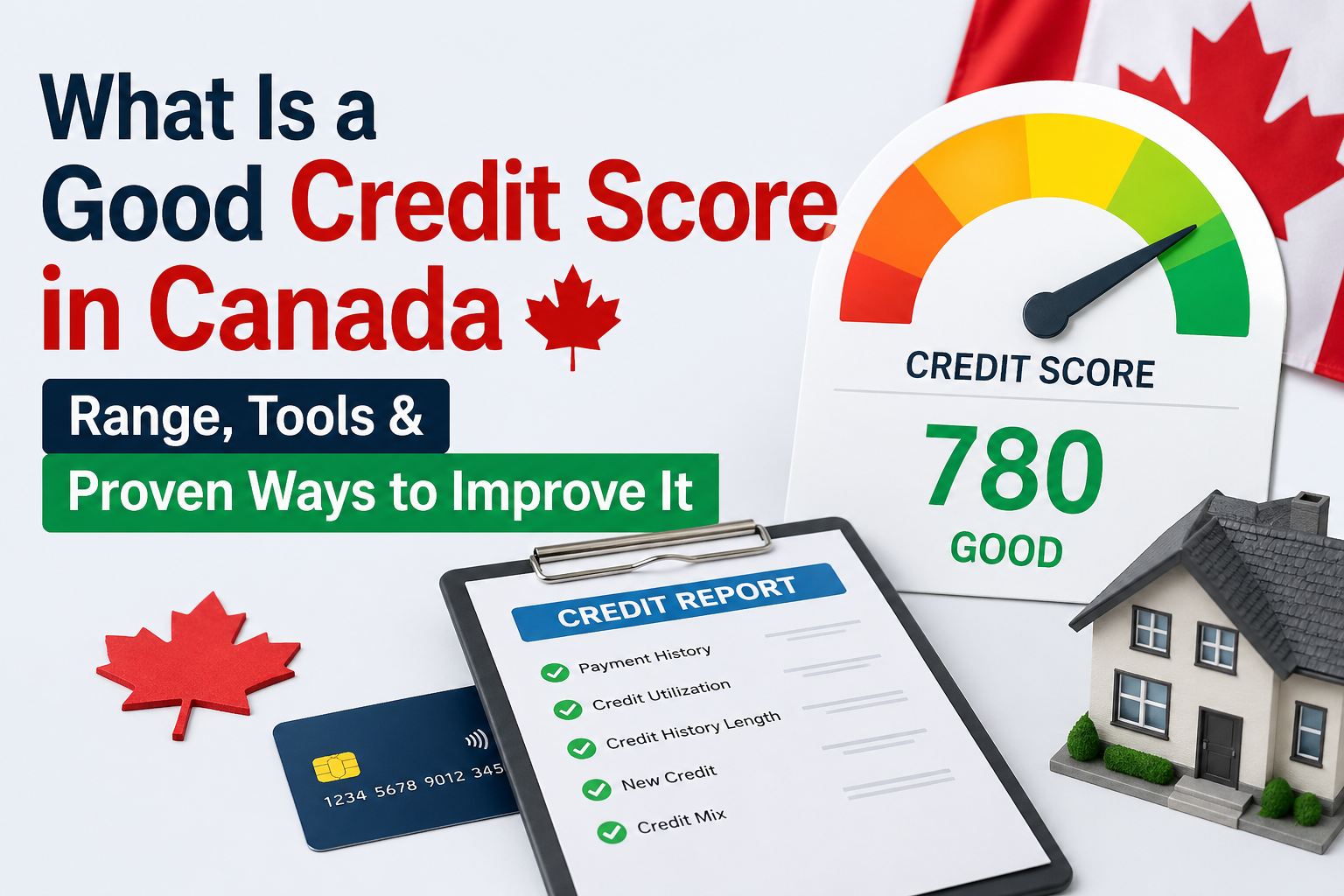
If you are looking to borrow, buy a mortgage, or rent a property in Canada, understanding your credit score is essential. A good credit score can give you access to many more ways to make money; while having a bad credit score will restrict options and increase your costs of borrowing money. This article will explore What is a Good Credit Score in Canada? Range, Tools & Proven Ways to Improve It in detail.
What is a Good Credit Score in Canada?
A credit score in Canada is a 3 digit number used by lenders to determine how reliable you are to pay back loans that have been made to you. Credit scores are calculated using your credit history and what kind of person you are financially, how you use credit and how you conduct yourself with financial products (e.g., credit cards, loans).
Two major credit bureaus in Canada calculate credit scores:
- Equifax
- TransUnion
Each may show slightly different scores depending on the data they have.
Here’s How to Check Your Credit Score & Credit Report in Canada for free
Credit Score Range in Canada
In Canada, credit scores generally range from 300 to 900. A score of 660 or higher is usually considered good, while 725 to 759 is very good and 760+ is excellent.
Credit score ranges in Canada
| Rating | Equifax Range | TransUnion Range | What It Means |
|---|---|---|---|
| Poor | 300–559 | 300–692 | Tough approvals; high rates |
| Fair | 560–659 | 693–742 | Possible approval; higher rates |
| Good | 660–724 | 743–789 | Reliable borrower |
| Very Good | 725–759 | 790–832 | Competitive rates |
| Excellent | 760–900 | 833+ | Best rates and terms |
Are Short Loans Really Costly? What You Should Know
Why your Credit Score Matters
Your credit score impacts more than just loan approvals. It can influence multiple areas of your financial life.
- With high credit ratings (660 and above), borrowers can qualify for better terms for their mortgages, car loans, and credit cards, i.e., a lower interest rate. Over the life of a loan, this could result in thousands of dollars saved. Low credit ratings could result in an application Denial or the need for a higher rate of interest with little to no chance of being approved.
- Most landlords will review potential tenants before deciding to rent an apartment. So, tenants with good credit ratings will have an easier time renting as there will not be a requirement to pay large deposits or have a co-signer.
- Utility companies may charge a deposit or installation fee to customers/clients that have low credit scores, however some may not require a deposit from customers/clients who have an 800+ or very high credit score when signing up for services.
- Many employers in financial services and/or government sectors check credit background. An employee who has a bad credit history would raise a red flag regarding the employee’s ability to handle responsibilities.
- In Ontario and similar provinces, individuals with higher credit scores will have an automatic savings on the cost of monthly premiums for auto and/or home insurance coverage.
Understand your Credit Score through Examples
Example 1: Good Credit Score (700)
- You apply for a credit card
- Bank sees score: 700
- Result: Approved easily
- Benefit: Normal interest rate and decent credit limit
Example 2: Excellent Credit Score (780)
- You apply for a home mortgage
- Lender sees score: 780
- Result: Approved quickly
- Benefit: Lower interest rate and better loan terms
Example 3: Fair Credit Score (620)
- You apply for a car loan
- Lender sees score: 620
- Result: Approved but with conditions
- Benefit: Higher interest rate and more total repayment
Example 4: Low Credit Score (550)
- You apply for renting an apartment
- Landlord sees score: 550
- Result: May be rejected or asked for co-signer
- Benefit: Higher deposit or added requirements
How Credit Scores are Calculated
Credit bureaus use several factors to calculate your score. Below are some factors that are being used by financial organizations to Calculate Credit Scores in Canada.
1. Payment History (35%)
Your payment history is the most important factor.
- Paying bills on time increases your score
- Missed or late payments will get it down
Check List of Top 5+ Bad Credit Credit Cards in Canada & Choose Smartly
2. Credit Utilization (30%)
This refers to how much of your available credit you are using.
- Keep usage below 30% of your credit limit
- Lower usage will improve your score
3. Credit History Length (15%)
The longer your credit history, the better is the score.
- Old accounts help build credibility
- Dont close your oldest credit card
4. Credit Mix (10%)
Having different types of credit is beneficial.
- Credit cards
- Installment loans (car loans, mortgages)
5. New Credit Inquiries (10%)
Applying for too much credit in a short time will hurt your score.
- Hard inquiries reduce your score on a temporary basis
Best Tools to Check Your Credit Score in Canada
You can check your credit score for free using several trusted platforms.
Free Credit Score Tools
- Borrowell: Provides free Equifax credit scores and reports
- Credit Karma Canada: Offers free TransUnion scores
- Equifax & TransUnion: Direct access (some services may be paid)
- Banks (RBC, Scotiabank, BMO): Many offer free credit score tracking
Checking your score will not hurt your credit as long as it’s a soft inquiry.
Proven Ways to Improve Your Credit Score
Improving your credit score requires regular effort, but these proven strategies work for Canadians. You should focus on the biggest factors: payment history and credit utilization.
- You must pay bills on time every month
- Keep credit card balances under 30% of limits
- Check and dispute errors on your credit reports
- Don’t close your oldest credit cards
- Dont apply for new credit cards every now and then
- Use secured credit cards if starting out
- Request credit limit increases (without spending more)
Common Credit Score Mistakes: You must Avoid
Many people unknowingly risk their credit scores with simple mistakes.
- Missing due dates or paying late
- Having multiple credit cards
- Applying for too many loans at once
- Ignoring credit report errors
- Closing old accounts without any reason
Avoiding above mistakes can protect your score and help it grow steadily.
How to Check your Credit Score for Free
In Canada, you can check your credit score for free using a number of different services that use soft inquiries and have regular updates of your Equifax or TransUnion data.
Here are some of the best options available:
- Borrowell.com – Offers a free Equifax score and full report; set up will take about three minutes, and you will get a new Equifax report every week after that.
- CreditKarma.com – Offers a free TransUnion score so you can monitor your credit score without having to use a credit card.
- Equifax.com – Offers a free online credit report once a month, and in some cases, a score.
- TransUnion.com – Offers a free online Consumer Disclosure report once per month.
- ClearScore.com – free forever access to your TransUnion score and report.
All of the major banks such as RBC, Scotiabank, TD, and CIBC (just to name a few) offer free access via their mobile apps.
Frequently Asked Questions (FAQs)
What would be a good credit score for Canada?
Any credit score above 660 is classified as good, and any above 760 is excellent.
Will checking my credit score affect it?
Not at all; this is a soft pull of your credit report and will not impact your score.
How long do you need to improve your credit score?
Small changes will happen within 1-3 months, while big changes can take 6-12 months.
Can one get a loan if he/she has a low credit score?
Yes, but you may face higher interest rates or stricter conditions.
Final Words
Having a good credit score in Canada means, better loan rates, easier rentals, and lower insurance costs. To start, check your credit score through Borrowell (Equifax) or Credit Karma (TransUnion). Other good practices include paying bills on time, keeping your credit utilization ratio below 30%, and resolving any errors on your credit report. Last but certainly not least, you should refrain from using up all the available credit on your accounts and you should never close old accounts.
Monitor your credit score on a monthly basis; by following good habits consistently over the next 3 to 6 months, your credit score will improve. Having a good credit score will have numerous long-term benefits, like being able to buy a house or secure a job. If you want to have those long-term benefits, you need to take responsibility for your credit score.
Sources
This article is based on verified financial data and trusted Canadian credit bureau guidelines to ensure accurate and reliable information about credit score ranges and ratings.

Ritika's writing philosophy is built on one core principle: every person deserves access to clear, accurate, and actionable benefit information — without having to wade through confusing government language. Her guides are trusted by seniors, working families, and low-income households across North America who rely on timely payment updates and eligibility information.
All content written by Ritika is thoroughly research-based, sourced from official government portals including SSA.gov, Canada.ca, and CRA publications.