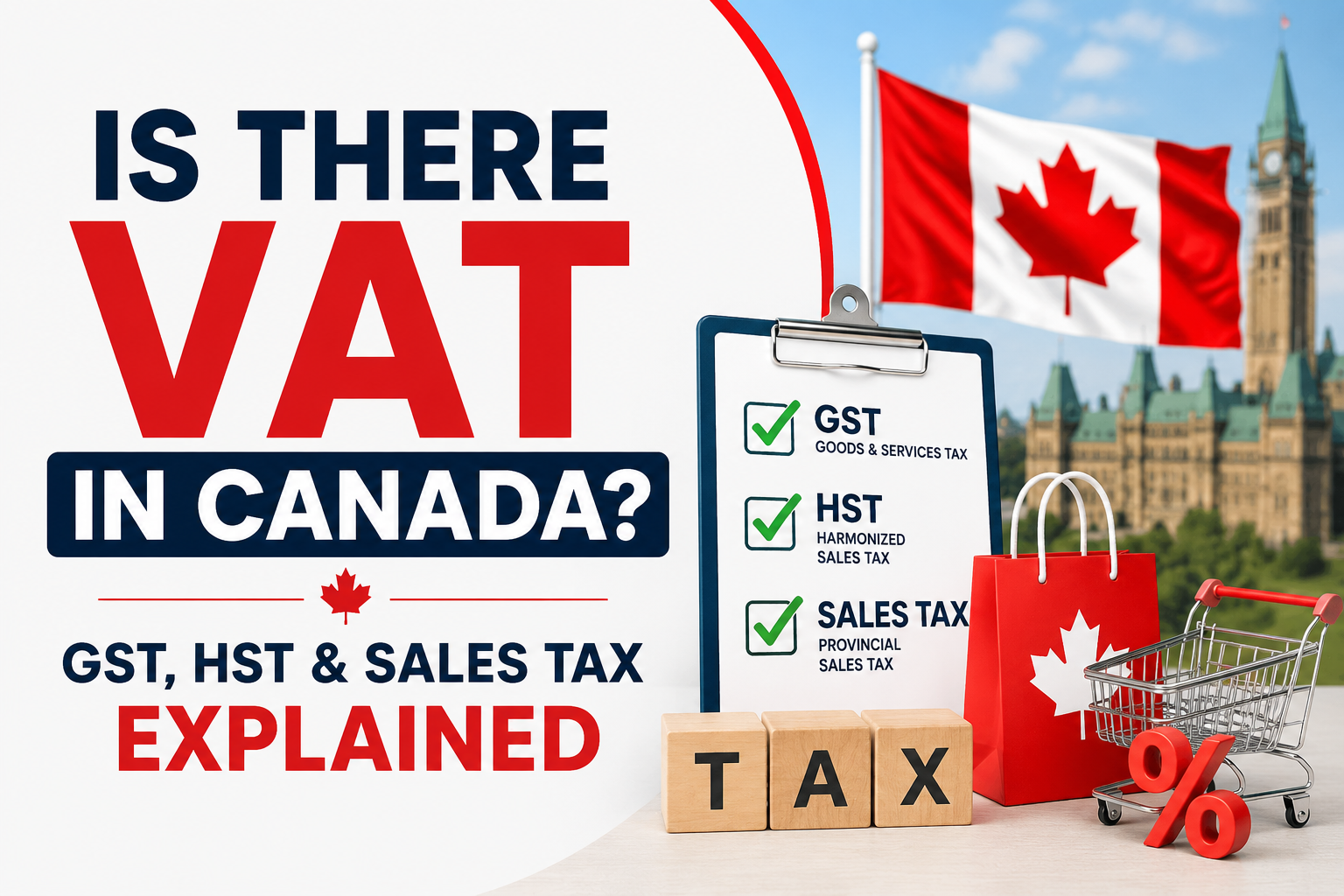
Many Canadians search for a common question- Is there VAT in Canada? The short answer is that Canada does not use a tax officially called “VAT.” However, the federal GST and HST are value-added taxes that operate similarly to VAT systems used in Europe and other countries. The Canadian taxation model uses either GST, HST, PST, or QST according to the province or territory.
It is essential for consumers, freelance workers, online vendors, and foreign companies to understand the sales tax model of Canada. This article will cover the basics of GST, HST, and provincial sales taxes of Canada in 2026, its payers, and the difference of VAT in Canada from the VAT of other countries.
Is There VAT in Canada?
Many people search for VAT in Canada due to familiarity with the value-added tax systems applied in Europe or elsewhere. In Canada, there is no tax officially named VAT. But Canada uses a combination of federal and provincial sales taxes that function as value‑added taxes from the point of view of consumers.
The system appears the same as a VAT, whereby tax is applied to nearly all products during transactions and businesses act as tax collectors on behalf of the government. For businesses, GST/HST represents a value-added taxation system wherein the majority of registered businesses are eligible to claim input tax credits, much like a traditional VAT system.
What is GST in Canada?
The Goods and Services Tax (GST) is Canada’s federal sales tax and is levied on most of goods and services sold throughout the nation. The general GST rate is 5%. The federal GST rate is fixed at 5% across Canada. In HST provinces, the provincial portion is combined with the 5% GST into a single Harmonized Sales Tax (HST).
The GST is considered a value-added tax because businesses can claim input tax credits for GST paid on eligible business expenses. Businesses are allowed to claim the amount paid as GST on their input purchases as an input tax credit if they are registered for GST purposes.
Businesses generally must register for GST/HST when their worldwide taxable revenues exceed $30,000 in a single calendar quarter or over four consecutive consecutive calendar quarters. Certain businesses, such as taxi and ride-sharing operators, have different registration rules.
What is HST & Which Provinces Use It?
The Harmonized Sales Tax (HST) refers to one sales tax applied in certain Canadian provinces that combines the GST and provincial sales tax. Rather than appearing as two separate taxes, the HST appears only as one tax charge.
👉 Read Also: What Is a T4E Form in Canada?This reduces confusion for shoppers as well as the retailers because they do not have to account for the two kinds of taxes individually but combine the two to give one. The HST charges are collected by the CRA and the proceeds are subsequently paid back to the provinces that apply the HST.
Provinces Using HST in 2026
| Province | HST Rate |
|---|---|
| Ontario | 13% |
| Nova Scotia | 15% |
| New Brunswick | 15% |
| Newfoundland and Labrador | 15% |
| Prince Edward Island | 15% |
Businesses in HST provinces collect one combined tax and remit it via CRA. HST rates can change if provincial governments adjust their portion of the tax. Businesses should always verify current rates through the CRA.
What about PST in Canada
PST in Canada stands for Provincial Sales Tax. It refers to the retail sales tax levied by particular provinces, apart from the federal 5% GST. Some provinces such as British Columbia, Saskatchewan, and Manitoba charge their own PST along with the 5% GST, thus making customers pay for both taxes separately.
👉 Read Also: How to Settle CRA Debt in CanadaUnlike GST/HST, PST is generally not recoverable through input tax credits, increasing business costs in some industries. In practice, this means a customer in a PST province will typically pay 5% GST plus a provincial PST rate, resulting in a higher combined sales tax than GST alone. Businesses engaged in selling goods to PST regions need to register individually in those jurisdictions, calculate and collect PST, and pay it to the province’s finance ministry, unlike in HST regions.
| Province | Type of Tax Used | Taxes Charged on Most Purchases |
|---|---|---|
| British Columbia | GST + PST | 5% federal GST + provincial PST |
| Saskatchewan | GST + PST | 5% federal GST + provincial PST |
| Manitoba | GST + PST (also called RST) | 5% federal GST + provincial PST/RST |
What is QST in Quebec?
QST stands for Quebec Sales Tax, is the sales tax that individuals pay to the government whenever they purchase various types of goods and services within Quebec province. In Quebec, both GST and QST apply to most taxable goods and services. Revenu Québec administers GST and QST for most businesses operating in Quebec under a special federal-provincial agreement.
QST tax is collected by the Government of Quebec, and most of the firms operating in Quebec must be registered to collect the tax.
👉 Read Also: 4 New CRA Benefit Payments Arriving in May 2026Quebec Sales Tax Rates 2026
| Tax Type | Rate |
|---|---|
| GST | 5% |
| QST | 9.975% |
| Combined | 14.975% |
Understand more on VAT in Canada Here
Canada Sales Tax Rates by Province 2026
This is one of the most searched topics and significantly improves SEO.
| Province/Territory | Tax System | Combined Rate |
|---|---|---|
| Alberta | GST | 5% |
| British Columbia | GST + PST | 12% |
| Saskatchewan | GST + PST | 11% |
| Manitoba | GST + PST/RST | 12% |
| Ontario | HST | 13% |
| Quebec | GST + QST | 14.975% |
| Nova Scotia | HST | 15% |
| New Brunswick | HST | 15% |
| Newfoundland and Labrador | HST | 15% |
| Prince Edward Island | HST | 15% |
| Yukon | GST | 5% |
| Northwest Territories | GST | 5% |
| Nunavut | GST | 5% |
Example: How Sales Tax Works in Canada
If you purchase a laptop priced at $1,000, the final amount paid depends on where you live.
| Province | Tax Rate | Total Cost |
| Alberta | 5% GST | $1,050 |
| Ontario | 13% HST | $1,130 |
| Quebec | 14.975% | $1,149.75 |
| Nova Scotia | 15% HST | $1,150 |
This is why the same product can cost different amounts across Canada.
Why People Call GST and HST as VAT Tax
People often call GST and HST as VAT tax due to the similarities between how the two systems work. These taxes apply at various points within the supply chain rather than only when goods and services are sold.
Also, the businesses that have registered for GST/HST may receive input tax credit for the tax paid for the purchase of inputs. Ultimately, it is the ultimate consumer who bears the burden of such taxation. The similarity of the system used to calculate GST/HST and VAT means that the former is regarded as the VAT in Canada.
VAT in Canada for Tourists
As an international visitor to Canada, you are generally subject to the same GST, HST, PST or QST rates as Canadian residents when you buy goods or services. There is generally no general tourist sales tax rebate program for tourists making most purchases anymore. Expect the listed price of most goods or services to include the tax.
VAT in Canada for Foreign Businesses
Foreign businesses selling digital products or services to consumers in Canada may be required to register for GST/HST and collect Canadian sales taxes.
Examples include:
- Streaming services
- Mobile apps
- Software subscriptions
- Online courses
- Digital memberships
- Cloud-based services
Foreign businesses should review current CRA registration requirements to determine whether GST/HST collection obligations apply.
Why Canada Uses Different Sales Tax Systems
Canada uses different sales tax systems because both the federal government and all the provinces have the right to impose a tax, and the decisions they make differ in nature. The federal government imposes a national GST at 5% in all provinces, while provinces have the option of imposing an additional PST/QST or combining it with the federal tax to form HST depending on their particular situation.
👉 Read Also: Canada OAS Clawback Rules ExplainedSome provinces prefer HST because it is easier to manage since they allow the federal government to collect one consolidated tax and then pay the provincial amount to the province, which helps minimize red tape for companies. Some provinces opt for PST or QST to to maintain more direct control over their tax base, tax rates, and exemptions despite the complexity of the tax system and the need for registration and filing by firms in various jurisdictions.
Differences between VAT in Canada and GST/HST
There is no official VAT in Canada. However, the GST and HST work in a manner very similar to VATs in other countries. Both systems are value-added taxes collected throughout the supply chain, imposed at various points along the distribution channel, provide tax credits for taxes paid by firms on purchases used in their businesses, and place the end cost of the tax burden on consumers.
The only significant difference between the 2 types of taxes lies in their structure: Other countries usually have one national VAT system, Canada uses the GST and HST on a provincial level together with PSTs and QSTs. Therefore, when discussing VAT in Canada, people should understand it as an application of the VAT concept to GST/HST taxation.
Sales Taxes in Canada’s Territories
| Territory | Sales Tax System |
|---|---|
| Yukon | 5% GST only |
| Northwest Territories | 5% GST only |
| Nunavut | 5% GST only |
FAQs
Does Canada have a VAT?
Canada does not officially use a VAT, but GST and HST function similarly to a value-added tax system.
What is the GST tax rate in Canada in 2026?
Federal GST in Canada is set at a rate of 5%.
How many provinces use the HST in Canada?
Ontario, Nova Scotia, New Brunswick, Newfoundland and Labrador, and Prince Edward Island use HST
Why does Canada use different sales tax systems?
Provinces can choose whether to use HST, PST, or QST along with the federal GST.
Wrap-Up
While technically there is no VAT in Canada, the country’s GST and HST systems function almost same to the VAT used in other countries. Individuals residing in Canada could be charged GST, HST, PST, or QST based on their location. It is crucial to understand Canada’s taxation system regarding sales tax in 2026 for citizens, immigrants, tourists, and companies.
With varying sales taxes applicable in various provinces, it would be beneficial to familiarize oneself with the tax laws. The understanding of Canada’s GST and HST taxation systems can prove useful whether you plan to start a business, immigrate to Canada, or even purchase items online.
👉 Read Also: Canada Installment Loans Explained for BorrowersSources
This article is based on official Canadian tax information and verified government resources explaining GST, HST, provincial sales taxes, and how Canada’s tax system differs from VAT systems used in other countries.

Nishant believes that access to clear financial information is a right, not a privilege. His articles consistently prioritize accuracy, transparency, and practical value — helping seniors, families, and working individuals stay on top of payment dates, eligibility changes, and benefit updates.
All content published by Nishant is research-based and sourced from verified government portals including SSA.gov, Canada.ca, CRA.gc.ca, and official provincial government websites.