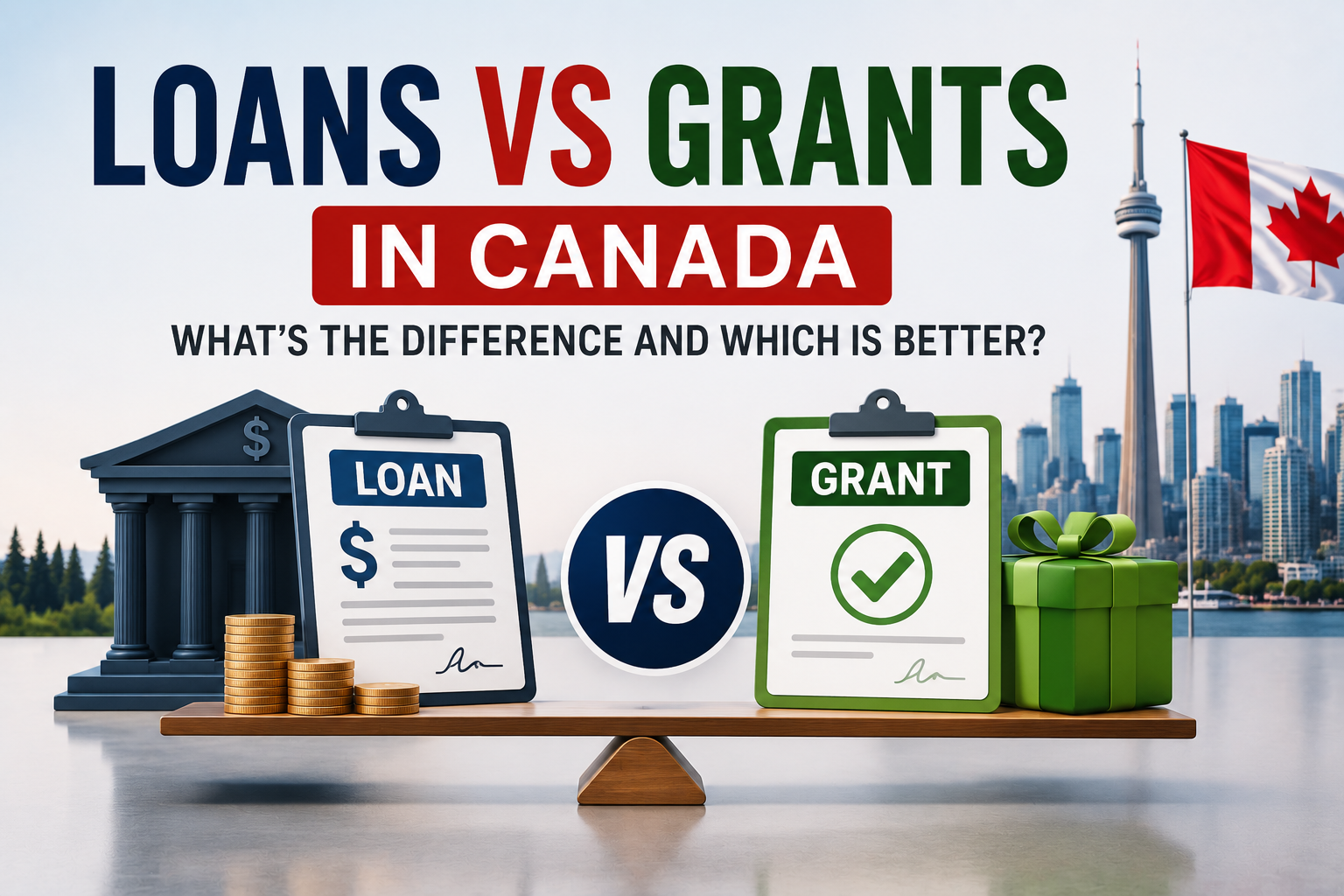
Loans vs Grants in Canada is one of the most searched financial topics among students, small business owners, and low-income families. Financing your goals, which may include starting a business, pursuing education, or improving your home can be done with the aid of two important financial options, and these are grants and loans.
In case you require some money to meet your financial objectives, it is important to familiarize yourself with the difference between the 2 options of finance. Below, i will explore the details of grants and loans, What’s the Difference and Which Is Better? for Canadians.
Loans vs grants in Canada: What is the Difference
While both a grant and a loan can provide you with the funds you need, they are 2 very different options, with pros and cons.
What is a Grant?
Grant is defined as any form of money that an organization or government awards to an individual, business entity or group of individuals towards particular programs or activities. Grants are usually offered depending on the need, merit or program proposal.
Therefore, to qualify for any grant, one must ensure that their needs and objectives fit in line with the grant goal. Grant does not involve repayment, making it more appealing to learners and businesses.
Common Types of Grants in Canada
- Student Grants: The Canadian government offers grants to eligible students based on family income, disability status, or dependents.
- Small Business Grants: Some government programs provide grants to support innovation, clean energy, technology, or local economic development.
- Housing Grants: Programs may help homeowners improve energy efficiency or make accessibility upgrades.
- Community and Nonprofit Grants: Organizations may receive grants for community projects, cultural programs, or social initiatives.
Examples of Grants in Canada
Example: Student Using a Grant
A college student from a low-income household receives a federal student grant that covers part of tuition and textbooks. Since the grant does not require repayment, the student graduates with less debt.
Example: Small Business Using a Grant
A Canadian clean-energy startup receives a government innovation grant to support research and product development. The funding helps reduce borrowing needs during the early stages of growth.
Example: Low-Income Household Using a Grant
A homeowner qualifies for a housing efficiency grant to install insulation and energy-saving upgrades, reducing future utility costs without taking on debt.
What is a Loan?
A loan is a little bit more complex compared to a grant, although individuals have more exposure to loans in their daily life experiences. A loan refers to borrowing of money that should be paid back together with extra money called interest at a later date.
Loans are generally more widely available compared to a grant and usually comes with more flexibility. There are thousands of loan providers offering loans to Canadians from all walks of life for whatever purpose.
Common Types of Loans in Canada
- Student loans: federal/provincial aid for tuition, books, living costs. They are often deferred while studying and may have repayment assistance.
- Personal loans: flexible funds for emergencies or repairs and usually unsecured with fixed monthly payments.
- Business loans: financing for growth, equipment, or cash flow and can be term loans, lines of credit, or government‑backed.
- Mortgage loans: long‑term, secured loans to buy a home and are typically repaid over 15–30 years.
- Auto loans: vehicle‑backed loans repaid over 3–7 years.
Examples of Loans in Canada
Example: Student Using a Loan
A university student uses a student loan to cover rent and transportation costs after grants only cover tuition expenses.
Example: Small Business Using a Loan
A restaurant owner takes a business loan to renovate the dining area and buy kitchen equipment before the busy summer season.
Example: Low-Income Household Using a Loan
A family takes a personal loan to repair a broken furnace during winter because emergency repairs cannot wait for grant approvals.
Loans vs Grants in Canada: A Comparison
Grants vs loans in Canada: Which Option is Better
Which option is better depends on your situation.
Grants are Better if:
- You qualify for government or foundation assistance based on eligibility rules.
- You want to avoid taking on debt and preserving cashflow.
- Your need is project‑specific (education, research, community, arts, green retrofits).
- You meet income‑based or demographic requirements for non‑repayable support.
Loans are Better if:
- You need a large sum quickly or on short notice.
- You don’t qualify for available grants.
- You have reliable income to manage scheduled repayments.
- You need flexible use of funds (equipment, working capital, home purchase).
Government Loans V/S Government Grants: Watch more in detail
Can You Use Both Grants and Loans Together?
Yes, you can use both grants and loans for the same project, as many Canadian companies and students do just that. The common combination is: grants finance the eligible parts of your project, such as R&D and delivery of programs and courses, while loans finance all other elements.
The main rules:
- Disclosure of any source of funding is important during your application process and your funding agencies will expect transparency.
- The total funding available through the public sector may not surpass 100% of your project costs and no double-counting the same expenses.
- Grants may have a ceiling on the amount of other funds from the public sector that can be used alongside them (such as another grant or tax credit).
- Interactions between Tax Credits and Grants: Specific tax credits (for example, SR&ED) may sometimes need you to subtract from the amount claimed the money that has been awarded to you via grants.
- Proper documentation and allocation: Ensure that the budget for your project reflects proper separation of each expense and ensure that all records and receipts are maintained.
Common Mistakes to Avoid
- Thinking grants are free money. Grants come with clear eligibility criteria, reporting requirements, and uses; failure to comply with them could lead to repayments or denial of funding in the future.
- Failure to take into account cash flow considerations. A lot of grants pay out after expenditure; you could be forced to borrow money to cover your initial costs.
- Taking out a loan without considering grants. Some ventures often receive grants for example, hiring, training, research and development, and energy savings upgrades.
- Neglecting the issue of stacking limitations. You could get a funding application rejected or be forced to make repayments for combining your funds wrongly.
- Expenses double‑claimed. Do not expense any budget line against more than one government entity; ensure proper allocation line by line.
- Failure to declare other sources. Almost all grant applications mandate full disclosure of government and public assistance.
- Downplaying administrative effort. Many grants involve reporting, auditing, and documentation; account for staff workload and resources.
- Neglecting indirect costs. Grants will not necessarily cover indirect costs, administrative fees, and contingency plans; know your limits.
- Relying on loan availability. A loan is depend upon creditworthiness, collateral, and cash flow management; take into account interest and stipulations.
Frequently Asked Questions
In Canada, do I have to pay back grants?
Generally, you are not obligated to repay most grants as long as you fulfill program obligations and use the funds correctly.
Are grants better than loans?
Grants are usually preferable to loans as you can create less debt. It is usually harder to acquire a grant than a loan.
Can businesses get both grants and loans?
Yes. Many Canadian businesses use grants and loans together to finance projects and expansion plans.
Do grants affect credit scores in Canada?
No, grants do not involve debt and consequently, will not appear on a credit report.
Wrap-Up
When comparing loans vs grants in Canada, grants will be the preferred choice since there is no need to repay them. Grants, however, have restrictions and eligibility requirements. On the other hand, loans offer quicker and larger financing but leave the individual with financial responsibilities that may take years to fulfill.
Therefore, the best strategy would be to seek grants first and resort to loans if need be. Regardless of whether one is a student, a home buyer, or a business man, understanding the pros and cons of both options can enable them to make an informed financial decision.

Nishant believes that access to clear financial information is a right, not a privilege. His articles consistently prioritize accuracy, transparency, and practical value — helping seniors, families, and working individuals stay on top of payment dates, eligibility changes, and benefit updates.
All content published by Nishant is research-based and sourced from verified government portals including SSA.gov, Canada.ca, CRA.gc.ca, and official provincial government websites.