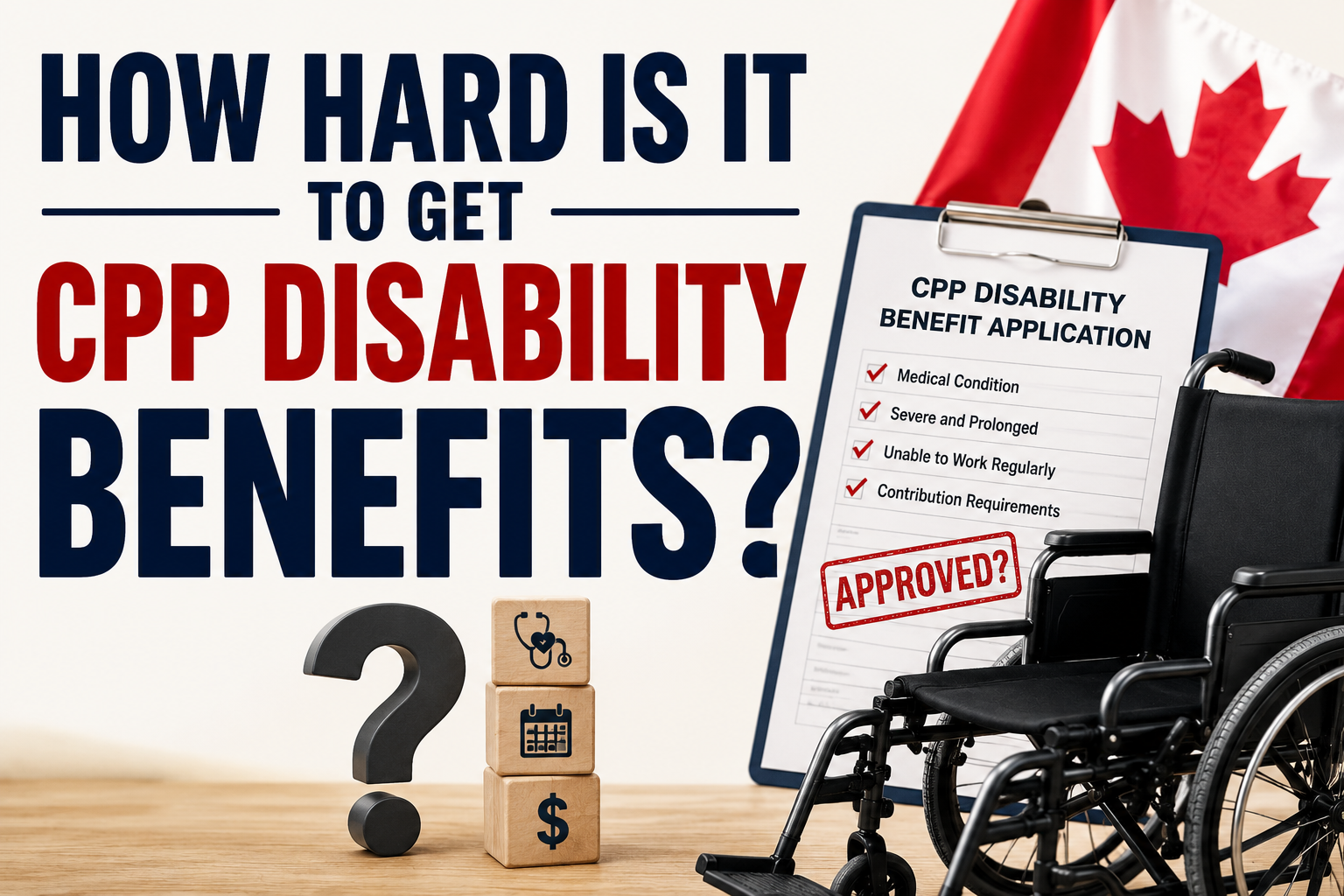
CPP Disability Benefits: When an illness or disability has led you out of the workplace, one question you may ask yourself is whether you would be eligible to receive Canada Pension Plan (CPP) disability benefits. One of the most common question from Canadians relates to the difficulty of receiving CPP disability benefits. The answer is not as simple as yes or no.
According to the Canada Pension Plan legislation, one needs to meet certain legal conditions rather than be diagnosed with a particular medical condition to qualify for these benefits.
The Canadian government provides CPP disability benefits via the service Canada. Every single case is reviewed individually based on the same legal criteria. Medical documents, the individual’s capability to perform any work, and his/her Canada Pension Plan record of contributions are all considered when evaluating your application.
This guide describes the process of obtaining CPP disability benefits, the potential candidates for them, and how they will be evaluated by the Service Canada based on the official Government of Canada guidelines.
What Are CPP Disability Benefits?
Canada Pension Plan (CPP) disability benefits refer to tax-free monthly income paid to qualifying individuals of the Canada Pension Plan with an ongoing mental or physical disability that precludes them from working on a regular basis.
The purpose of such program is to provide some compensation for your lost employment income due to a disability that makes it unfeasible for you to earn a living. As compared to individual disability insurance, the former is regulated by federal laws and therefore, the evaluation of each application is based on uniform criteria.
Eligibility for CPP disability benefits is not granted automatically upon your diagnosis. Service Canada will determine whether your disability qualifies according to criteria defined within the Canada Pension Plan. Instead, every application is assessed individually based on:
- Medical condition and level of functionality.
- Severity of the disability.
- Prolonged period of time.
- CPP contribution status.
- Medical documentation provided by medical professionals.
This individual evaluation is the reason why two individuals with the same disease can get different decisions.
Official Eligibility Requirements
To receive CPP disability benefits, you must usually meet all of the following requirements.
| Age | Be under 65 years old. |
| CPP Contributions | Have made enough valid CPP contributions. |
| Disability | Have a severe and prolonged mental or physical disability. |
| Work Capacity | Be regularly incapable of working at any substantially gainful occupation. |
Meeting only 1 or 2 of these requirements is not enough. Service Canada evaluates every part of your application before making a decision.
What Does “Severe” Mean?
A disability is said to be severe according to the Canada Pension Plan when the disability is such that it regularly prevents an individual from engaging in any form of substantially gainful occupation. This does not necessarily mean that one must be confined to bed or unable to do the usual things. Rather, Service Canada considers whether the disability keeps you from being employed. This is about how you can work and not about your diagnosis.
For example: one individual could have the condition of arthritis but still be able to work on a full-time basis through some adaptations within the workplace. Another person who has been diagnosed with the same disease may suffer from severe pain and loss of mobility to an extent that he or she cannot work.
That is why applications to Service Canada are reviewed on a case-by-case basis instead of using the list of pre-approved diseases.
What Does “Prolonged” Mean?
In addition to being serious in nature, the disability has to be prolonged. The Government of Canada states that this means that the disability should be either:
- Of indefinite duration and long term, or
- Likely to lead to the individual’s death.
Temporary medical conditions or injuries that can eventually heal usually fail to satisfy this criterion. In this regard, your doctor or specialist is instrumental in telling you about how your condition may progress.
What is “Substantially Gainful Occupation”
The term “substantially gainful occupation” is one of the least-understood elements of CPP disability eligibility requirements.
In simple language, Service Canada evaluates whether an individual is capable of working and earning money from it rather than just being able to go back to their former job.
For example, in case a construction worker becomes unable to do physically demanding work due to the injury to his spine, Service Canada will evaluate the overall picture in order to establish whether this person is still able to engage in substantially gainful employment. The decision is made in consideration of the person’s health condition, his restrictions and the criteria of the Canada Pension Plan. Every application is evaluated on its own merits.
Canada CPP Contribution Requirements
Medical eligibility alone is not enough and you must also have contributed sufficiently to the CPP. In most cases, applicants must satisfy one of the following contribution rules.
| Contribution Requirement | General Rule |
| Standard Rule | Valid CPP contributions in 4 of the last 6 years. |
| Long-Term Contributor Rule | If you have contributed for at least 25 years, valid contributions in 3 of the last 6 years may satisfy the requirement. |
Some situations, such as the late applicant provision, may involve additional rules. Service Canada determines contribution eligibility using your CPP contribution record.
Medical Evidence Lays the Basis for Your Claim
Medical evidence forms one of the key elements in any CPP disability claim.
It consists of a medical report compiled by your health care professional describing your medical condition, symptoms, treatment history, functional limitations, and prognosis. The Government of Canada will use this information to assess whether your disability qualifies under the legal definition of disability in the Canada Pension Plan.
The mere diagnosis is not sufficient. It is vital to present clear medical evidence of how your disability interferes with your ability to work regularly.
The following can be considered useful information:
- Diagnostic test results and your medical background.
- Your current health issues.
- Reports from specialists.
- Records of the hospitals where you have been treated.
- Results of tests, if applicable.
- Treatment that you have undergone.
- Response to treatment.
- Limitations on functioning.
- Duration of your disability.
Full disclosure of your medical history enables the Canada Service Center to evaluate your claim based on the most accurate data.
Reviewing a CPP Disability Claim By Service Canada
Upon receiving your claim, the process of carefully examining both your contribution history for CPP and any medical information included with your claim will begin. Each claim will be assessed separately on the eligibility criteria of the Canada Pension Plan.
In assessing your claim, decision makers may take into account:
- Your level of CPP contributions.
- The severity of your disability as per the definition of severe disability according to the law.
- Whether your disability is long term or not.
- The medical opinion of your doctor or specialist.
- Whether more information is needed in order to make an informed decision.
If Service Canada requires further information, it may contact you or your health care professional. It is always helpful to provide as much information as possible initially to avoid delays.
Steps to Apply for CPP Disability Benefits
The Government of Canada recommends that any individual who believes he or she is qualified should submit an application immediately. Failure to do so may affect the date of commencement of benefits in case of successful approval of the application.
Most applicants should follow these steps:
| 1 | Confirm that you meet the age, contribution, and disability requirements. |
| 2 | Complete the CPP disability application via My Service Canada Account (MSCA) or use the paper application package. |
| 3 | Ask your doctor or nurse practitioner to complete the required medical report. |
| 4 | Submit all required forms and supporting documents to Service Canada. |
| 5 | Respond as soon as possible in case Service Canada asks you for more information. |
| 6 | Wait until Service Canada evaluates your application and provides a written decision. |
Making sure that the application is complete before submitting it can prevent delays
How Eligibility Is Assessed- Understand It With Example
The examples below have been provided solely for educational purposes and do not constitute any guarantee of approval. The information provided should not be taken as legal advice.
Example 1: Temporary Disability
An injury occurs to an employee at work resulting in a broken leg and the patient is expected to heal completely after 8 months. Although this injury may make the individual unfit to work for some time, it will not satisfy the criterion of prolonged nature as far as the medical evidence shows full recovery.
Example 2: Progressive Neurological Disorder
An individual suffering from progressive Parkinson’s disease continues to experience deteriorating symptoms even though he/she has been receiving continuous treatment. In case all other eligibility criteria, including those concerning CPP contributions, are met, then the individual might be eligible since this disability may satisfy both severe and prolonged criteria.
Example 3: Mental Disability
An individual suffers from serious depression and anxiety, which persist despite treatment. There is a record of considerable impairment in functioning such that he is unable to work regularly. Service Canada makes no distinction between physical disabilities and mental disabilities. The determining factor is whether the medical evidence shows that the disability satisfies the criteria set out in the CPP.
Common Mistakes Applicants Do
Applications can be strengthened by avoiding some common mistakes made while filing the application.
Applying Too Late
According to the Government of Canada, an applicant should file his/her application immediately he/she feels she is eligible. This is because an applicant who files his/her application late can risk delays in receipt of any benefits that his/her application gets approved.
Making a Diagnosis Mean Everything
It is not enough just to have a diagnosis; there must be medical evidence showing how the applicant is limited to doing regular work.
Filing Insufficient Medical Information
An application with sufficient medical evidence helps Service Canada to understand the extent of the disability and its effects.
Forgetting Specialist Reports
In case specialists have been treating you, their reports could contain useful information concerning your medical condition.
Ignoring Requests for More Information
It will be in your best interest to promptly answer requests from Service Canada to avoid any delays in processing your application.
What Happens If Your Application Is Rejected ?
It is important to note that rejection does not mark the end of the process. If you disagree with Service Canada’s decision, you have the right to request a review. In this process, your application is re-reviewed along with any other material that you choose to submit. If you remain dissatisfied after the reconsideration decision, you can appeal to the Social Security Tribunal of Canada.
What Next Once Your Application Gets Approved?
In case your application is approved, Service Canada will inform you of:
- The start date of your benefits.
- The amount to be paid out each month.
- Your obligations after being granted CPP disability benefit.
According to the Canada Pension Plan, CPP disability benefits continue so long as you qualify for the same. In some cases, there can be an assessment of your eligibility based on any changes in your health status. At the age of 65 years, your CPP disability benefits will automatically stop and CPP retirement benefits take over.
CPP Disability V/S CPP Retirement Pension
Many people confuse these 2 programs because they are both administered under the CPP.
| CPP Disability Benefits | CPP Retirement Pension |
| Requires a severe and prolonged disability. | No disability is required. |
| Available only to eligible contributors under age 65. | Can generally begin as early as age 60, with adjustments based on your starting age. |
| Requires sufficient CPP contributions & medical eligibility. | Requires sufficient CPP contributions but no medical assessment. |
| Generally ends at age 65 and converts to a CPP retirement pension. | Continues throughout retirement. |
So, Is It Hard To Get CPP Disability Benefits?
Understanding how hard it is to get CPP disability benefits starts with knowing the official eligibility criteria of the CPP disability benefit program and not common myths or personal opinions. The Government of Canada evaluates each application independently based on the legal criteria outlined in the Canada Pension Plan Act.
In order to be eligible for the benefit, one has to prove that there is enough CPP contribution and the existence of severe and prolonged disabilities which make a person unable to perform substantial gainful activity.
Be sure to consult the official guidelines before filing an application, have enough medical information available, and fill out the application correctly. A well-filled-out application will give enough information for Service Canada to reviews your situation objectively.
FAQ’s
Is it hard to get CPP disability benefits?
The eligibility criteria will depend on whether one meets the criteria set out in the Canada Pension Plan. The medical evidence and work ability and past CPP contributions will be reviewed by Service Canada.
Will the medical condition automatically make me eligible?
No. Canada does not have a list of conditions that will automatically make an individual eligible. Every application is considered individually based on your disability being severe and prolonged.
Are mental conditions qualified for CPP disability benefits?
Yes. Both mental and physical disabilities are assessed using the legal eligibility criteria under the CPP.
What should I do if my application is rejected?
You have the right to submit a reconsideration claim to Service Canada. In case of disagreement, you can file an appeal with the Social Security Tribunal of Canada.
Disclaimer
The above article is for informational purposes only and is based on official Government of Canada guidance. CPP disability eligibility is determined individually by Service Canada under the CPP. Always refer to Canada.ca for the latest information.
Official Sources

Ritika's writing philosophy is built on one core principle: every person deserves access to clear, accurate, and actionable benefit information — without having to wade through confusing government language. Her guides are trusted by seniors, working families, and low-income households across North America who rely on timely payment updates and eligibility information.
All content written by Ritika is thoroughly research-based, sourced from official government portals including SSA.gov, Canada.ca, and CRA publications.