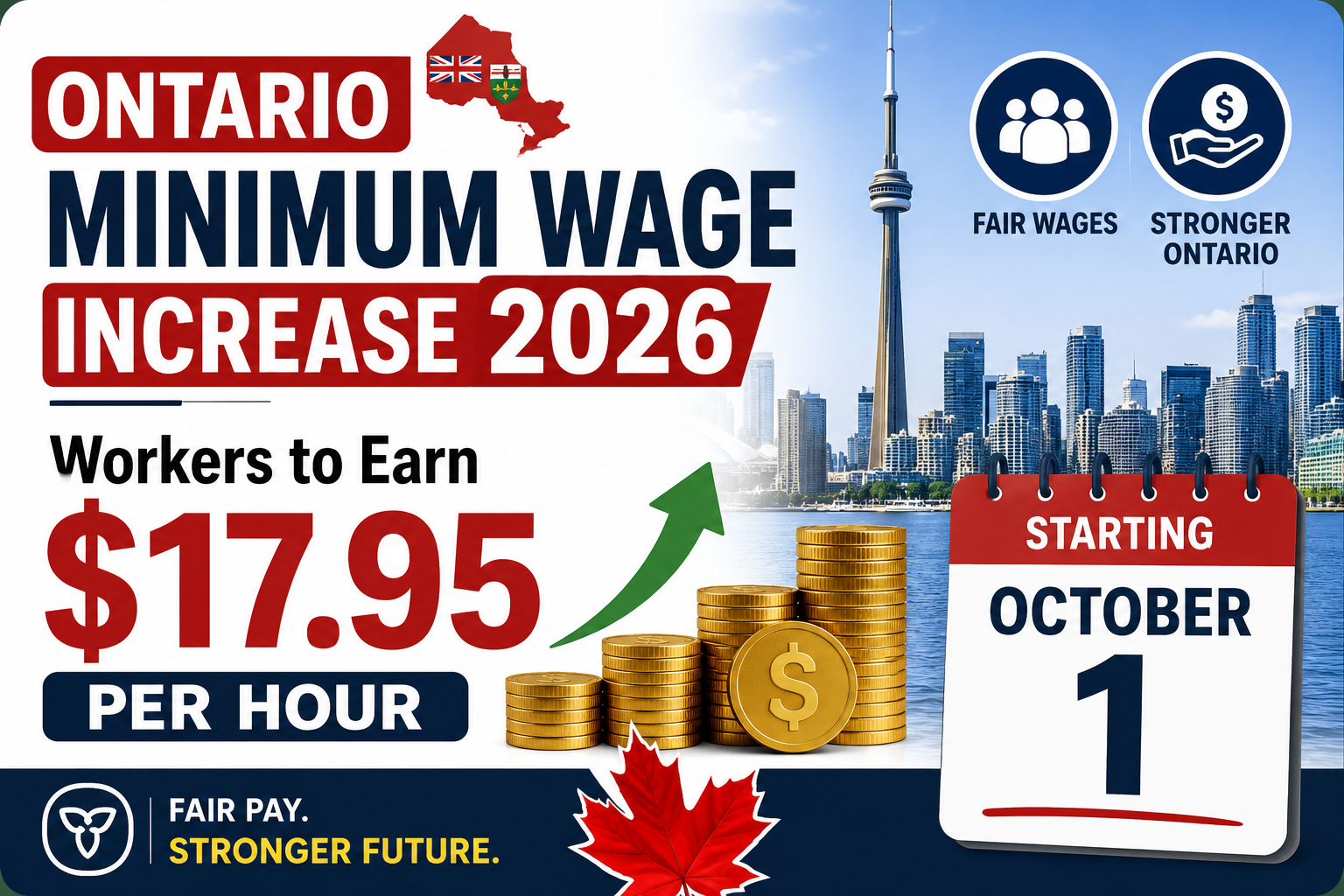
Ontario Minimum Wage Increase 2026: The Ontario government will be increasing the minimum hourly wage for all employees from $17.60 to $17.95 on October 1, 2026, helping over 700,000 people in Ontario. This 1.9% annual adjustment in Ontario’s minimum wage is linked to the Consumer Price Index in Ontario, which ensures wages remain reflective of economic factors while securing the interests of workers.
This is a practical step that will enhance the competitiveness of Ontario while supporting workers’ financial well-being amidst uncertain global economic circumstances.
Ontario Minimum Wage Increase 2026
An additional hike in minimum wage will be witnessed by employees in Ontario who work for at least minimum wage in the year 2026. According to the latest announcement from the Provincial Government of Ontario, there will be an increase of minimum wage from $17.60 to $17.95 for the general minimum wage rate that will take effect on October 1, 2026.
The increase in the minimum wage rate is based on inflation and will apply to most employees who are covered by the Employment Standards Act (ESA) in Ontario. This increase is expected to benefit over 700,000 employees working in Ontario, giving low-wage earners a small wage boost amid their efforts to catch up with inflation.
Official Government Announcement
“Ontario workers are the engine of this province,” said David Piccini, Minister of Labour, Immigration, Training and Skills Development. “By raising the minimum wage to one of the highest in Canada, our government is putting more money in the pockets of Ontario workers, supporting families through economic uncertainty and giving businesses the stability and predictability they need to plan and grow.”
Ontario Minimum Wage Rates by Job Type
The following minimum wage rates apply in Ontario:
| Job Category | October 1, 2025 to September 30, 2026 | Effective October 1, 2026 |
|---|---|---|
| General Minimum Wage | $17.60 per hour | $17.95 per hour |
| Student Minimum Wage | $16.60 per hour | $16.90 per hour |
| Homeworkers Wage | $19.35 per hour | $19.70 per hour |
| Hunting, Fishing and Wilderness Guides (less than 5 consecutive hours in a day) | $88.05 per day | $89.75 per day |
| Hunting, Fishing and Wilderness Guides (5 or more hours in a day) | $176.15 per day | $179.50 per day |
Example: How Much Will You Earn?
Example 1 for a full time worker: A worker who works 30 hours a week at minimum wage would earn $528.00 per week before October 1, 2026 at $17.60 an hour. From October 1, 2026, that same schedule would pay $538.50 per week at $17.95 an hour, a difference of $10.50 per week.
Example 2 for a student worker: A student under 18 working 20 hours a week during the school term would earn $332.00 per week at the old student minimum wage of $16.60. Starting October 1, 2026, that would rise to $338.00 per week at $16.90, an increase of $6 per week.
Example 3 for a Homeworker: A homeworker paid at the minimum wage for 25 hours a week would move from $483.75 to $492.50 per week, a gain of $8.75 weekly. Ontario defines homeworkers as employees doing paid work in their own homes.
How Ontario Sets Minimum Wage Each Year
The minimum wage in Ontario is revised every year according to the changes in the cost of living using the Ontario Consumer Price Index (CPI). The aim of the inflation index linked adjustment is to ensure that the minimum wage stays at par with the rising cost of living.
Ontario New minimum wage rates 2026 are usually made known during the spring season, specifically by April 1, after which they come into effect by October 1 in the same calendar year. For instance, the rise in minimum wage from $17.60 to $17.95 per hour in 2026 reflects the application of this yearly CPI-linked formula for ensuring that wages keep up with cost of living expenses such as rent, groceries, and gas.
Workers to Earn $17.95 Per Hour Starting October 1
Workers in Ontario will earn $17.95 per hour from October 1, 2026, following the rise of Ontario’s general minimum wage from $17.60 per hour. These provisions apply to almost all workers employed in Ontario, under the Employment Standards Act, 2000 (ESA), regardless of whether they work full-time, part-time, casually, or hourly and are engaged in various industries like retail, tourism, healthcare support, and warehousing.
The rise of the Ontario general minimum wage by 35 cents per hour (around 1.9%) is in line with Ontario’s yearly inflation-linked minimum wage adjustment, based on the Ontario Consumer Price Index (CPI). According to the Ontario government, this provision will help around 700,000 workers in Ontario. If a worker works for 40 hours per week, this provision will yield about $728 annually in net pay before taxes.
Who is Covered by Ontario Minimum Wage Increase 2026?
Most employees in Ontario who work in provincially regulated workplaces are entitled to receive at least the applicable minimum wage under the ESA. This includes workers who are paid:
- Hourly wages
- Salary
- Commission
- Piece rate
Minimum wage protections generally apply to:
- Full-time employees
- Part-time workers
- Casual employees
- Temporary workers
According to the Ontario government, employers must ensure employees earn at least the minimum wage for all hours worked, regardless of the payment structure. (Ontario.ca – Minimum Wage Rules)
What About Federal Minimum Wage?
The Ontario minimum wage does not apply to employees working in federally regulated industries. These sectors are governed by the Canada Labour Code and include industries such as:
- Banking and financial services
- Telecommunications
- Postal and courier services
- Airlines and airports
- Interprovincial transportation
- Railways
The federal minimum wage increased to $18.15 per hour effective April 1, 2026. The Government of Canada adjusts the federal minimum wage annually based on inflation using the CPI.
Impact on Ontario Employers
For those employees who have the right to be paid the minimum wage, employers in Ontario need to make sure that they pay at least $17.95 an hour, effective from October 1, 2026. This applies to employees receiving wages in hourly, salary, commission, and piece rate forms, but not to those classified as a special-rate or exempt employee in accordance with the Employment Standards Act, 2000 (ESA).
The increased cost of labour will have implications for business operations and may lead to changes, such as increasing prices, reducing working hours, using automation, and reviewing staff levels; however, research on previous wage increases in Ontario indicates that effects on employment have not been significant thus far.
The other issue is for the companies to check their payroll system and time card systems to make sure that they apply the new rate accurately and calculate any overtime correctly, which is 1.5 times the minimum wage beyond 44 hours per week. Companies that don’t meet these requirements may be penalized under the ESA.
Wrap-Up
Ontario Minimum Wage Increase 2026 rate to $17.95 per hour in 2026 is reflective of the efforts by the province to find a delicate balance between the increasing cost of living and economic stability. Although the increase in minimum wage is not significant, it provides a considerable boost to the livelihoods of many workers.
From an employee’s perspective, this development results in increased income and security. From an employer’s perspective, this is simply a reminder of their responsibility to remain compliant with the current labour regulations and economic conditions.
Overall this annual adjustment can be seen as quite crucial to maintaining justice at the place of work while taking into account the economic situation.

Ritika's writing philosophy is built on one core principle: every person deserves access to clear, accurate, and actionable benefit information — without having to wade through confusing government language. Her guides are trusted by seniors, working families, and low-income households across North America who rely on timely payment updates and eligibility information.
All content written by Ritika is thoroughly research-based, sourced from official government portals including SSA.gov, Canada.ca, and CRA publications.