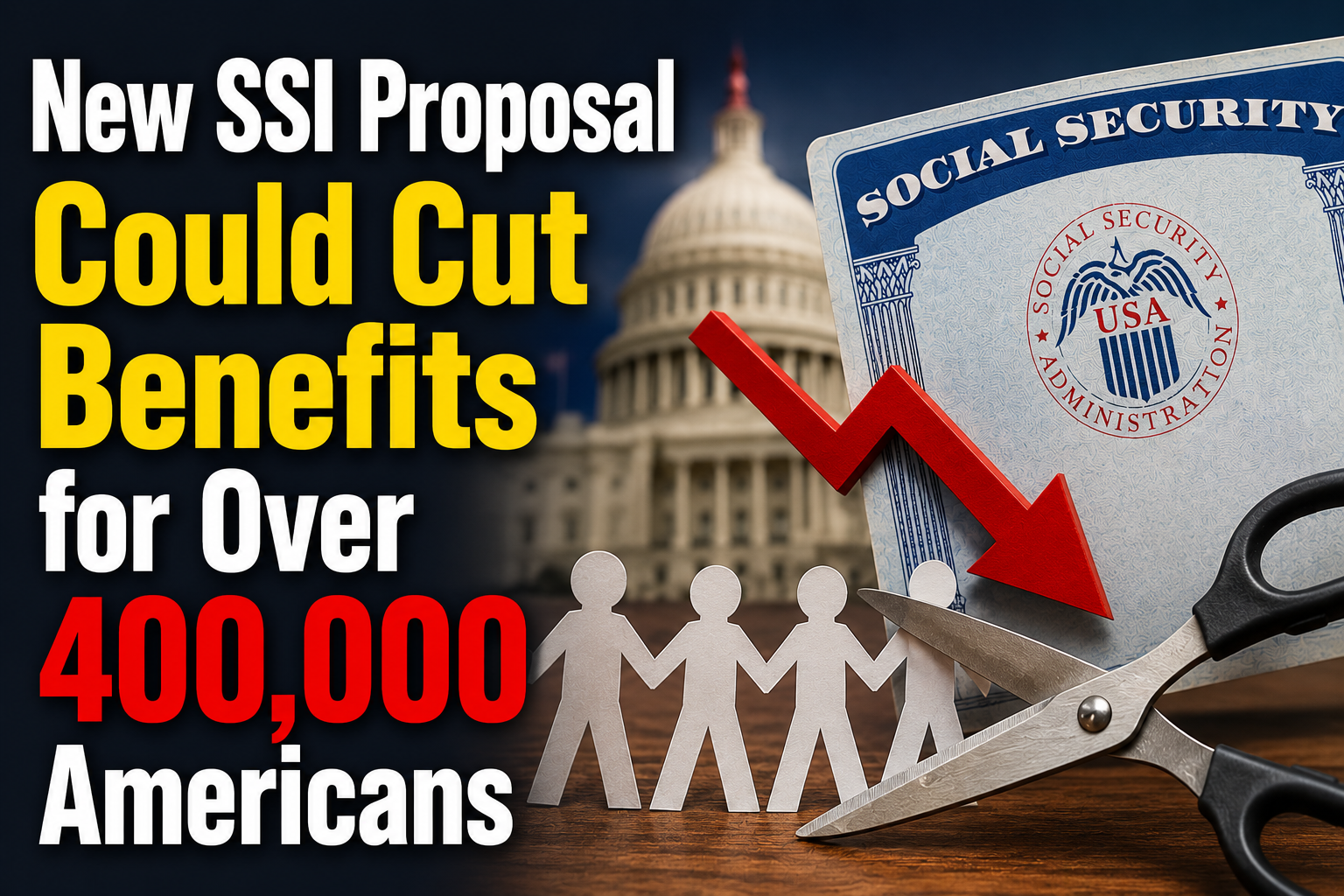
SSI Benefits cut 2026: A new proposal by Social Security may affect more than 400,000 Americans whose Supplemental Security Income may now become lower or no benefits at all. The new proposed rule would reverse a recent expansion to the definition of the public assistance household in relation to SSI, thus making it more difficult for some disabled and elderly poor people to access the benefit program.
As stated by the Center on Budget and Policy Priorities, the current administration is planning to repeal the rule and, as a result, reduce SSI benefits for almost 400,000 individuals. MassLive also mentions that the change in the rule may impact the disabled American population negatively.
What New SSI Proposal Would Change
At present, people on SSI who live in poor homes have some protection against benefit cuts if any household member is receiving any public assistance benefits like food stamps. In 2024, Social Security extended the definition of “public assistance household” to cover SNAP participants.
With the current proposal, however, the government would change its approach to previous practice, which stated that everyone in a home must receive some form of qualifying public assistance to become eligible for protection. It means that SNAP benefits would not provide automatic protection for SSI beneficiaries from housing deductions. Consequently, the government would be able to count free housing provided by family members as an income source.
Why This Rule Matters For SSI Beneficiaries
The proposed SSI rule matters because many recipients are on low monthly wages and depend upon their families for their housing and other basic needs. The inclusion of housing under the SSI policy might reduce the monthly incomes of certain beneficiaries.
Under the current laws, the status of being a public assistance household protects the recipient from any kind of reductions up to a third of their income. By rolling back the policy, the proposed policy would take away the status of being a public assistance household. Therefore, all members of the household must receive a qualified public assistance payment.
It may be very difficult for those households providing care to disabled persons to satisfy that criterion. Recipients receiving protections under the current policies will see their SSI payments substantially reduced. SSI federal maximum benefits in 2026 amount to $994 per month. Upon applying the reduction penalty to the SSI benefits, there will be a loss of about $331, which will leave a monthly total benefit amounting to $663 per month.
How Many Could Lose or see SSI Benefits Cut 2026?
Analyses from the CBPP, among other organizations, suggest that about 400,000 American citizens may potentially be affected by the rule.
This includes roughly the following breakdown:
- Approximately 277,000 individuals currently receiving SSI may have their benefits reduced, usually by about one third.
- There may be 109,000 additional individuals eligible to receive SSI but will either be ineligible or receive lower benefits because of the new rule.
How Benefits Could be Reduced by New Rule
The proposal would change how SSA evaluates the value of free housing provided by relatives. For example, if an adult with disability stays in a room rent-free with his or her parents, the SSA may consider the housing as income.
The amount determined as income would lower the monthly SSI benefit. Currently, SSI beneficiaries are subjected to reductions when they get in-kind supports. However, protections added in recent years helped shield many low-income households from these penalties. This would revert to the older rules implemented in the past. Based on certain sources, the beneficiaries risk losing about a third of their SSI benefit.
Example of a Potential SSI Benefits Cut 2026
An SSI recipient who is now receiving the full 2026 federal SSI payment of $994 per month could see benefits reduced if the value of their housing is counted as support.
For example:
| Situation | Estimated Outcome |
|---|---|
| Disabled adult lives with low-income parents receiving SNAP | Currently protected |
| Under proposed rule | Bedroom/housing value may count as income |
| Possible SSI reduction | Up to roughly 1/3 of benefits |
Given that the maximum federal SSI benefit amount stands at $994 per month, one-third of that comes out to be $331, which would leave them with about $663. Policy experts warn this could leave many vulnerable Americans with reduction in payment each month.
Who Could Be Affected by the New Proposal?
In case strict SSI housing supports policy changes are put in place, it may affect low-income Americans who depend on relatives or live as part of a larger family household. According to policy experts and disability advocates, the changes in the housing support policy would mostly affect the SSI beneficiaries who currently have living arrangements that offer them protection against benefits cuts as per the public assistance household policy.
People Most Likely to Be Affected:
- Adults with Down syndrome
- Individuals with severe autism
- People with dementia
- Low-income seniors
- Disabled adults living with parents or adult children
- Families already receiving SNAP benefits
Why the Administration is Proposing Change
Even though this rule has not yet been adopted, the new proposal comes in light of the growing debate surrounding the sustainability of social security programs. Currently, there is a problem of funding gap, which may result in cuts of benefits for all people starting from the early 2030s.Although this new rule will help to reduce the spending of the government on SSI, it will affect the most disadvantaged segments of society the most.
Official SSA Statement
According to an SSA spokesperson:
“The proposed rule would return us to the longstanding criteria and policies that were in place for decades before 2024. We do not expect this return to the status quo to create unnecessary red tape or cause an increase in workload for SSA staff.”
What Happens Next
The proposed SSI rule change is not final and is currently under review. The SSA will then have to issue the proposal for public comment through the Federal Register, which will provide a 60-day window for receiving input from interested parties.
Following evaluation of comments received, the SSA will determine if the rule should be implemented, revised or withdrawn. If implementation proceeds, the law will come into effect 30–90 days after its issuance.
The entire process may take up to a year, and can still be altered or stopped for various reasons. In the meantime, existing SSI rules continue to apply, including the 2024 SNAP protection.
Wrap-Up
The debate about potential SSI rule revisions is raising fears among many vulnerable seniors, people with disabilities, and their relatives who depend on Supplemental Security Income to cover their needs. Although policy experts and advocacy groups have pointed out that new requirements for housing-related benefits may impact many hundred thousand people, there were no confirmed national reductions of SSI in May 2026.
The current SSA rules related to housing benefits and in-kind income are already in place, and the proposed changes will be approved after the formal approval and discussion procedure by the authorities. As of now as a SSI beneficiary, you must follow existing rules, consult official information from the Social Security Administration, and not believe unverified rumors appearing online and on social media.
Frequently Asked Questions
What is the new SSI proposal?
The Social Security Administration (SSA) has proposed a rule change that would define SNAP (or food stamps) as a benefit not part of public assistance households. It will apply for calculating SSI benefits to people with disabilities and older adults who live in homes of relatives on SNAP programs.
How many could be affected?
This may affect up to 400,000 citizens; 277,000 of them currently receiving SSI benefits whose benefits will be reduced while about 109,000 more might lose their eligibility to receive the said benefit in the coming years.
Is there any SSI benefits cut 2026?
As of May 2026, there is no existing implementation of a reduction in the SSI benefit.
Is this Rule change final yet?
No. The proposal is still under review and it may take time.

Nishant believes that access to clear financial information is a right, not a privilege. His articles consistently prioritize accuracy, transparency, and practical value — helping seniors, families, and working individuals stay on top of payment dates, eligibility changes, and benefit updates.
All content published by Nishant is research-based and sourced from verified government portals including SSA.gov, Canada.ca, CRA.gc.ca, and official provincial government websites.