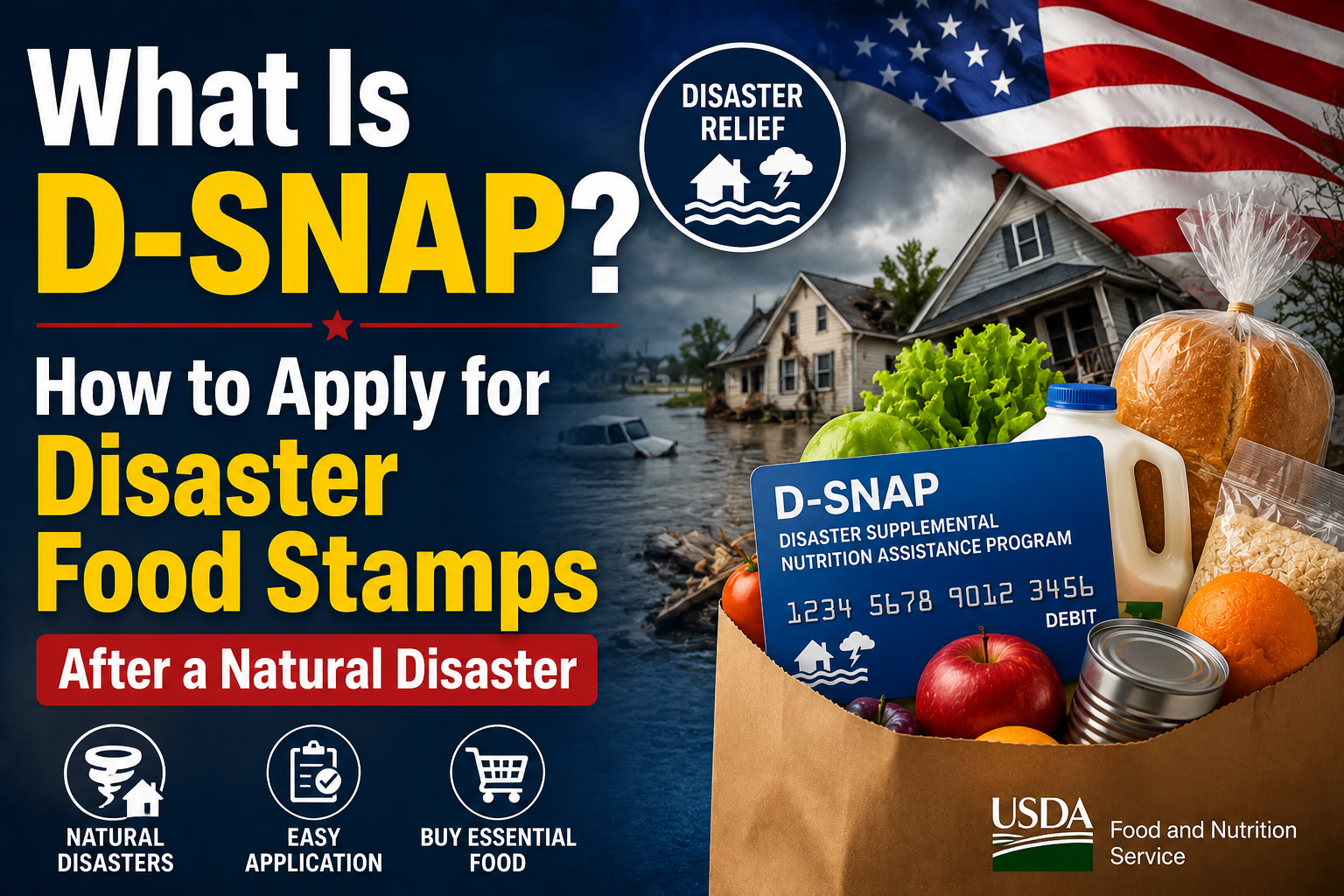
D-SNAP: When a hurricane leaves you without power for days, a wildfire forces a family to flee their home, or a flood takes the family’s home and livelihood, food is almost always one of the first problems to arise. Refrigerators stop running, grocery stores may be closed for days at a time and people may suddenly have loss of income, hotel expenses and unexpected emergency costs on top of that.
In these situations, the federal government has a program designed to help known as the Disaster Supplemental Nutrition Assistance Program (D-SNAP), it provides temporary food assistance to households affected by major disasters. The program can provide temporary food benefits for disaster-affected households.
Although most Americans know of the SNAP program (formerly referred to as food stamps), not as many are aware of a separate disaster program. What makes D-SNAP special is that its use can help households that normally wouldn’t qualify for traditional SNAP benefits.
A family that was doing fine financially before a disaster might suddenly qualify due to loss of income, temporary housing expenses, damage to property or loss of food from spoilage due to the emergency. Knowing how D-SNAP benefits work might give your household food resources when your community has been affected by a federally declared disaster.
What Is D-SNAP?
D-SNAP, an emergency food assistance program administered by the state and under the USDA authority, is designed for survivors of natural disasters who are unable to purchase food when a disaster strikes, causing them to be faced with a need.
It is an emergency food assistance program available through the states after disasters have occurred and are approved by the USDA for counties/states when families cannot afford to buy groceries.
Unlike regular SNAP benefits available to all low-income eligible households year-round, D-SNAP is made available following disaster events as needed and when state entities and USDA approve. The benefits can be accessed through an Electronic Benefit Transfer (EBT) card, which functions like a debit card for the purchasing of groceries from eligible retailers and stores.
Not all storms, fires or floods require the implementation of D-SNAP programs, they must be authorized by the states and approved by the USDA.
Why D-SNAP Exists
The financial reality of disaster events are something that assistance programs were not built to accommodate. Consider the case of a household who can typically manage to meet all of its expenses. A hurricane comes along, preventing one family member from working because business is closed. The family spent nights in a hotel, disposed of expensive perishable foods due to the lack of electricity, and started paying for damages.
This family typically does not qualify for regular SNAP, but there is a drastic change in its financial state over night. D-SNAP is designed to address this situation. This program acknowledges that even financially secure households may be experiencing disaster-related financial distress on a temporary basis.
How D-SNAP is Different from Regular SNAP
One of the largest misconceptions people have about D-SNAP is that it is just extra SNAP benefits. In fact, eligibility rules differ for both programs. The main things looked at for regular SNAP are household income and resources; whereas D-SNAP looks at how much a disaster affected household’s finances.
Disaster expenses like temporary lodging, evacuation costs, emergency repairs, and lost food can be taken into account when calculating benefits. Therefore, a household who makes too much money for regular SNAP may still get D-SNAP benefits. This flexibility is just one of the ways D-SNAP has proven itself to be crucial in U.S disaster recovery.
Who is Eligible for D-SNAP?
| You May Qualify If | Details |
|---|---|
| You live in the disaster area | Your home is located in a county or area approved for D-SNAP assistance. |
| You lost income because of the disaster | Your workplace closed, your hours were reduced, or your business was affected by the disaster. |
| Your home or belongings were damaged | The disaster caused damage to your house, vehicle, or personal property. |
| You had to evacuate | You spent money on hotels, transportation, or temporary housing because you had to leave your home. |
| You lost food during a power outage | Food in your refrigerator or freezer spoiled because the electricity was out for an extended period. |
| You had unexpected disaster expenses | You paid for cleanup, repairs, emergency supplies, or other disaster-related costs. |
| You meet the program’s financial rules | The state reviews your income, available money, and disaster-related expenses to determine eligibility. |
| You apply on time | D-SNAP is only available for a limited period after a disaster, so you must apply during the official application window. |
Examples of Households That May be eligible
| Household Situation | May Qualify? |
|---|---|
| Family forced to evacuate after a hurricane | Often eligible |
| Worker who lost income because a business closed after a flood | Often eligible |
| Homeowner whose refrigerator food spoiled during a power outage | May qualify |
| Renter whose apartment became uninhabitable after a wildfire | Often eligible |
| Self-employed contractor unable to work because of disaster damage | May qualify |
| Household outside the approved disaster area with no disaster-related losses | Generally not eligible |
What Expenses May Be Covered?
Most disaster survivors are unaware that eligibility is not based on income. Your state agency might look at the following disaster related expenses:
- Emergency shelter expenses
- Home repair expenses
- Transportation costs related to evacuation
- Cost of replacing food
- Cost of medical treatment of a disaster related injury or illness
- Cost of debris removal
Since each disaster is unique, it’s best for applicants to look for state-agency guidelines once enrollment is open.
What Can D-SNAP benefits be used for?
Once approved, families can receive benefits on an EBT card that they may use at authorized food vendors.
Benefits may be used to buy such items as:
- Fruits and vegetables
- Meats, poultry, and fish
- Dairy products
- Breads and cereals
- Snack foods
- Non-alcoholic beverages
As with SNAP, D-SNAP may not be used to purchase alcoholic beverages, tobacco products, vitamins, household and cleaning products, or pet food. The objective is to help families continue to have access to nutritious food during the restoration phase.
How Much Money Will I Receive?
The benefit amount you get with D-SNAP depends primarily on household size and the maximum SNAP benefit amounts active at the time of the disaster. Most eligible households receive a benefit amount equivalent to the maximum SNAP allotment for your household size, intended to offset grocery expenses as families rebuild.
For instance, larger families would likely receive more financial assistance than smaller ones, given the increased need for food.
Your D-SNAP benefit amount will depend on:
- Your household size
- Disaster declaration
- The current federal maximum SNAP benefit levels
- Whether you already receive SNAP benefits
Once D-SNAP is approved, the State Agency will inform the household of benefit amounts and other eligibility guidelines
How to Apply for D-SNAP After a Natural Disaster
Applying for D-SNAP is easier than many think but also extremely time sensitive. States typically open up periods where the state accepts D-SNAP applications and each household must submit the application within that window.
The initial step is to ensure that your state has been approved to allow for D-SNAP applications. States will typically release this information via government web sites, the office of emergency management, local news stations, and social media.
When application windows open, individuals may be required to share their address, identification, details about their household, their income and details about the costs associated with their disaster.
Most states offers different application methods, including in-person enrollment centers, temporary disaster recovery sites, telephone interviews, and online applications..
Following submission, there may be an interview that an individual has to complete to determine eligibility.
Those individuals that have been approved are typically sent benefits quickly so that individuals can get the food needed right away.
What are The Common Mistakes That Delay Applications
A list of common errors:
- Waiting until near the end of the enrollment window
- Not keeping records of food losses
- Throwing away receipts related to the cost of accommodation or leaving your home
- Incomplete reporting
- Getting information from unofficial social media rather than from the government
How Will I Receive Benefits?
If you are approved for D-SNAP benefits, these benefits will be loaded on an Electronic Benefit Transfer (EBT) card. The EBT card is similar to a debit card and may be used at any eligible food retailer, including grocery stores and supermarkets, that accepts EBT.
If you are already an EBT card holder from a previous SNAP case, your benefits may be added to your existing card. Otherwise, the state may issue a new EBT card to you.
Important: Protect Yourself From D-SNAP Scams
Scammers often try to take advantage of victims of natural disasters, so keep in mind:
- The USDA does not ask for an application fee.
- No legitimate agency will ask you to pay for the processing of benefits.
- Do not provide sensitive information through unofficial Web sites.
- Confirm details with your state agency or appropriate government office.
- Report suspicious activities to your local authorities or government agencies.
Wrap-Up
D-SNAP is a disaster food assistance program that helps individuals and families during a natural disaster. If you have experienced loss of income, home destruction or disaster-related expenses and do not normally receive SNAP benefits, you may be eligible for disaster assistance.
Since application periods are typically very limited, be sure to apply as soon as possible and to watch for any state and federal updates regarding your application status from your state SNAP office and the USDA. D-SNAP is designed to provide you with an ability to feed your family while you get back on your feet.
FAQ’s
What is D-SNAP?
D-SNAP is a temporary food assistance program to help low-income households affected by a federally declared disaster purchase food during and after disaster recovery.
Who can Apply for D-SNAP?
Eligibility requires residence or work in a designated disaster area, along with losses directly related to the disaster, such as loss of income, damaged or lost property, or destroyed food.
Do I have to get regular SNAP to be eligible for D-SNAP?
No, many households that do not normally qualify for regular SNAP could be eligible after a disaster.
How do I apply for D-SNAP?
You have to apply through your states SNAP agency during the application period declared for that disaster.
Sources
This article is based on official USDA guidance, SNAP program resources, and publicly available disaster assistance information from U.S. government agencies.

Nishant believes that access to clear financial information is a right, not a privilege. His articles consistently prioritize accuracy, transparency, and practical value — helping seniors, families, and working individuals stay on top of payment dates, eligibility changes, and benefit updates.
All content published by Nishant is research-based and sourced from verified government portals including SSA.gov, Canada.ca, CRA.gc.ca, and official provincial government websites.